How Does Bitcoin Mining Work? Understanding Hash Rate, Difficulty, and Block Rewards
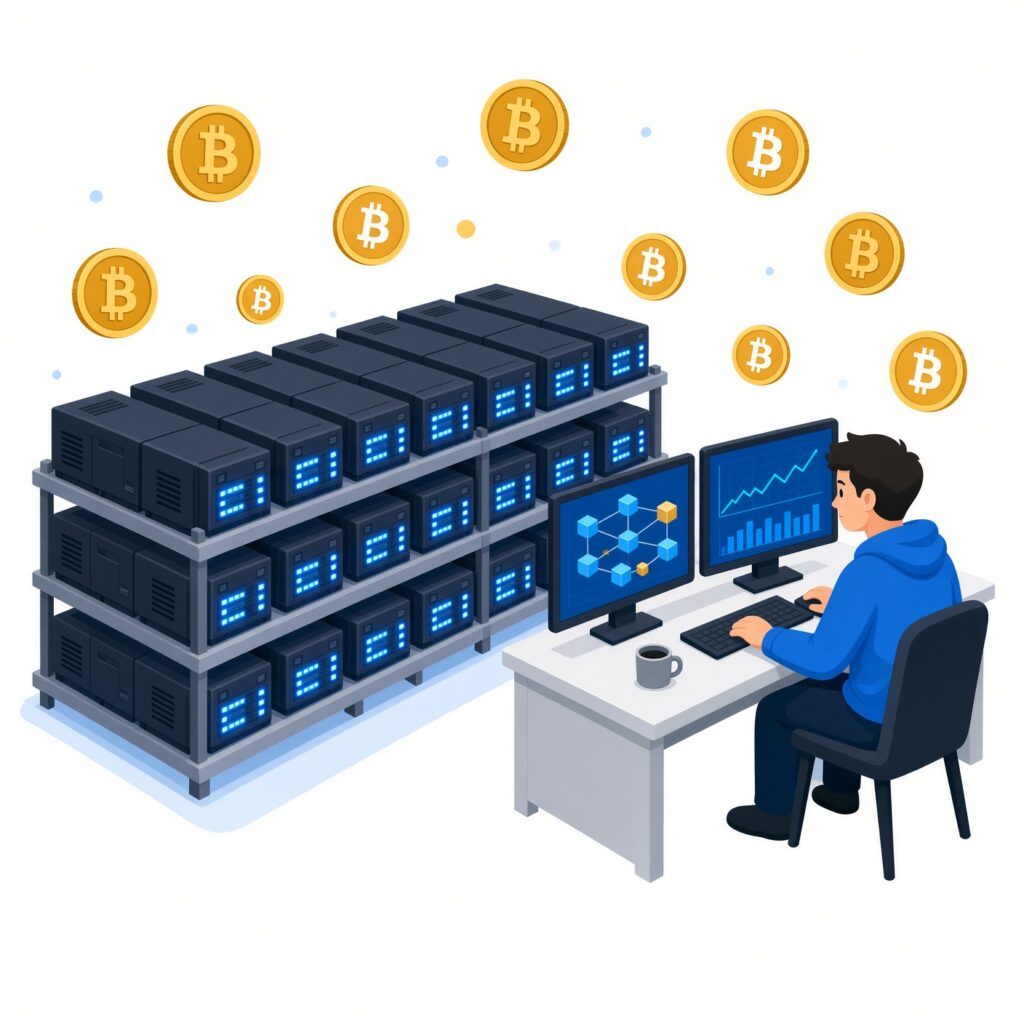
imagem meramente ilustrativa.
Bitcoin mining often sounds like an esoteric concept reserved for computer scientists and financial technologists. Mention it in casual conversation, and images of massive server farms humming away in cold climates, solving complex equations on glowing screens, usually come to mind. While the scale of modern mining operations is indeed industrial, the core principles governing the Bitcoin network are elegant, mathematical, and surprisingly accessible once you break them down.
At its heart, Bitcoin mining serves two fundamental purposes: it introduces new Bitcoins into circulation, and it secures the peer-to-peer network by verifying transactions. Unlike traditional fiat currencies controlled by central banks, Bitcoin has no physical mint or governing authority. Instead, it relies on a decentralized ledger—the blockchain—maintained by participants worldwide. Mining is the mechanism that keeps this ledger honest, secure, and continuously updated.
Understanding how this ecosystem functions requires looking beneath the surface of everyday transactions. To truly grasp the engine driving the world’s leading cryptocurrency, we need to examine the architecture of the blockchain, the mechanics of proof-of-work, the crucial roles of hash rate and mining difficulty, and the economic incentives that keep miners coming back block after block.
The Fundamentals of Bitcoin Transactions and the Blockchain

To understand mining, you first need to understand what miners are actually doing. Every second, users around the globe initiate Bitcoin transactions—sending funds from one digital wallet to another. These transactions cannot just float in cyberspace; they need to be grouped together and permanently recorded.
When you send Bitcoin, your transaction enters a holding area known as the memory pool, or mempool. Think of the mempool as a digital waiting room. Miners pull pending transactions out of this waiting room and bundle them together into a candidate block. A block is essentially a digital page of a ledger, capable of holding thousands of individual transactions.
However, miners cannot simply write this page to the permanent ledger—the blockchain—whenever they feel like it. They must earn the right to do so. This is where the consensus mechanism known as Proof-of-Work (PoW) comes into play. Proof-of-work requires miners to expend real-world resources—specifically, electrical energy and computational power—to validate transactions and protect the network against malicious actors.
The Engine of Proof-of-Work: Cryptographic Hashing
The core puzzle that miners solve is cryptographic in nature. Specifically, Bitcoin uses the SHA-256 (Secure Hash Algorithm 256-bit) cryptographic hash function.
A hash function is a mathematical algorithm that takes an input of any size and transforms it into a fixed-size string of characters. In the case of SHA-256, no matter what data you feed into the algorithm—whether it is a single word or the entire text of War and Peace—the output is always a 64-character hexadecimal code.
Crucially, hash functions possess a few unique properties that make them ideal for blockchain technology:
-
Deterministic: The exact same input will always produce the exact same output.
-
One-Way: It is computationally impossible to reverse-engineer the input by looking only at the output.
-
Avalanche Effect: Changing even a single character in the input completely alters the resulting hash.
Miners take the data from their candidate block—including the list of transactions, a reference to the previous block, and a random variable called a nonce (number used once)—and run it through the SHA-256 algorithm. Their goal is to generate a hash output that falls below a specific target value determined by the network.
Because the output is entirely unpredictable, miners cannot use logic or strategy to find the winning hash. They can only rely on brute force: changing the nonce slightly, hashing the data again, and repeating the process billions or trillions of times per second until someone hits the winning combination.
Decoding Hash Rate: The Measure of Computational Muscle
As the Bitcoin network grew from a small experiment among cryptography enthusiasts into a global financial network, the competition among miners skyrocketed. This brings us to our first core metric: hash rate.
Hash rate measures the total computational power being used by the Bitcoin network to process data and solve cryptographic puzzles. It is typically measured in hashes per second (H/s), scaling up to kilohashes, megahashes, gigahashes, terahashes, and even petahashes per second as the network expands.
To visualize hash rate, imagine a massive room filled with athletes competing in a lottery where the tickets are generated by rolling dice. The hash rate is essentially the collective speed at which all the athletes are rolling their dice. A higher hash rate means more trials are happening per second across the entire network.
Why Hash Rate Matters
Hash rate serves two vital functions in the Bitcoin ecosystem:
-
Network Security: A higher hash rate makes the network exponentially more secure. To successfully execute a “51% attack”—where a malicious entity attempts to rewrite transaction history—the attacker would need to control more than 50% of the total network hash rate. With Bitcoin’s hash rate reaching historic highs, the cost of electricity and hardware required to mount such an attack makes it economically prohibitive.
-
Miner Efficiency: For individual miners or mining pools, a higher hash rate increases the statistical probability of finding a valid block hash first, thereby earning the block reward.
Over the years, the hardware used to generate hash rate has evolved dramatically. In the early days of Bitcoin, individuals could mine effectively using a standard home computer CPU. As mining intensity increased, miners transitioned to Graphics Processing Units (GPUs), which offered significantly higher parallel processing capabilities. Today, the industry is dominated by Application-Specific Integrated Circuits (ASICs)—highly specialized computer chips designed exclusively to perform SHA-256 calculations with maximum energy efficiency.
The Self-Adjusting Scale: Understanding Mining Difficulty
If hash rate represents the accelerator pedal of the Bitcoin network, mining difficulty is the steering mechanism that keeps the vehicle on the road.
Satoshi Nakamoto, the anonymous creator of Bitcoin, designed the protocol with a strict rule: a new block must be added to the blockchain approximately every 10 minutes. If blocks were found too quickly, the total supply of Bitcoin would be mined too fast, destabilizing the economic model. If blocks took too long, the network would become sluggish and unusable for everyday transfers.
However, because hash rate fluctuates wildly—miners constantly turn machines on or off based on electricity prices, hardware upgrades, and market conditions—the time required to solve blocks would naturally vary. To prevent this, Bitcoin incorporates a automatic difficulty adjustment mechanism.
How the Difficulty Adjustment Works
Roughly every two weeks (specifically, every 2,016 blocks), the Bitcoin protocol automatically evaluates how long it took to mine the previous 2,016 blocks.
-
If miners mined those blocks in less than two weeks (averaging under 10 minutes per block because hash rate increased), the network automatically increases the difficulty target. The puzzle becomes harder to solve.
-
If miners took longer than two weeks (because hash rate dropped and machines went offline), the network decreases the difficulty target. The puzzle becomes easier.
This adjustment happens entirely autonomously, without human intervention or central oversight. It ensures that regardless of whether millions of new ASICs join the network or a massive portion of mining operations shut down overnight, the block time remains locked remarkably close to that 10-minute target.
The Economic Reward: Block Rewards and Transaction Fees

Why do individuals and corporations invest millions of dollars in specialized hardware, warehouse space, and electricity? The answer lies in the economic incentives built directly into the protocol: block rewards and transaction fees.
When a miner successfully solves the cryptographic puzzle and adds a new block to the blockchain, they are granted the right to collect newly minted Bitcoins. This incentive is known as the block reward.
The Halving Schedule and Scarcity
When Bitcoin was launched in 2009, the block reward was set at 50 Bitcoins per block. To ensure that Bitcoin maintains a predictable and deflationary supply cap of 21 million coins, Satoshi implemented a rule: after every 210,000 blocks (roughly every four years), the block reward is cut in half.
This event is known as the halving.
-
In 2012, the reward dropped to 25 BTC.
-
In 2016, it dropped to 12.5 BTC.
-
In 2020, it dropped to 6.25 BTC.
-
In 2024, it dropped to 3.125 BTC.
This programmed reduction in supply is a core pillar of Bitcoin’s economic design. As the rate of new coin issuance slows down, the marginal new supply entering the market decreases, mimicking the extraction curve of precious commodities like gold.
Transaction Fees
In addition to the newly minted block reward, miners also collect all the transaction fees attached to the transactions included in their block. When users send Bitcoin, they can optionally include a small fee to incentivize miners to prioritize their transaction over others in the mempool.
As the block rewards continue to halve over the decades, transaction fees will gradually take over as the primary economic incentive for miners. Once all 21 million Bitcoins have been fully mined—projected to happen around the year 2140—miners will rely exclusively on transaction fees to cover their operational costs and secure the network.
Mining Pools: The Collaborative Approach to Modern Mining
For an individual sitting at home with a single mining rig, the probability of finding a valid block hash first is akin to winning a massive lottery with a single ticket. Because the global hash rate is so immense, solo mining has become largely unviable for independent operators.
To smooth out income and make mining predictable, participants organize into mining pools.
A mining pool is a collaborative group of miners who combine their computational power over the internet. When the pool successfully mines a block, the resulting block reward and transaction fees are distributed proportionally among all participants based on the amount of hash rate they contributed.
While this approach reduces the variance of payouts—turning mining into a steady, reliable stream of income rather than a high-risk gamble—it also centralizes a degree of operational coordination. However, miners can switch pools at any time, ensuring that power remains decentralized across the global community.
The Broader Impact and Environmental Considerations
No discussion of Bitcoin mining is complete without addressing its broader footprint, particularly regarding energy consumption. Because proof-of-work requires substantial computational effort, mining operations consume significant amounts of electricity.
This energy consumption has sparked vibrant global conversations. Critics point out the carbon footprint associated with running millions of industrial ASICs, particularly in regions reliant on fossil fuels. Conversely, proponents highlight unique characteristics of Bitcoin mining that differentiate it from traditional industries:
-
Location Independence: Mining rigs can be set up anywhere there is cheap electricity. This has driven miners to remote areas to tap into stranded energy sources—such as excess natural gas flared off at oil extraction sites or curtailed renewable energy from wind and solar farms that would otherwise be wasted due to transmission grid limitations.
-
Grid Stabilization: Mining operations can act as flexible load balancers for electrical grids. During periods of peak renewable energy generation, miners can consume surplus power; during periods of high demand, they can instantly shut down their equipment to free up capacity for residential and commercial users.
As the industry matures, miners are increasingly gravitating toward geothermal, hydroelectric, solar, and wind power to lower operational expenses and align with corporate sustainability goals.
The Future of Securing the Decentralized Economy

Bitcoin mining is far more than a technical process for minting digital currency; it is the foundational trust layer of the world’s first successful decentralized financial network. By marrying game theory, cryptographic mathematics, and economic incentives, the protocol creates a self-sustaining ecosystem where participants are rewarded for acting honestly and maintaining the integrity of the ledger.
From the foundational flow of transactions through the mempool to the complex calculations driven by global hash rates, every component works in harmony to protect the network against tampering. The ingenious difficulty adjustment mechanism ensures steady pacing, while the programmatic halving schedule hardcodes scarcity into the digital asset’s DNA.
Whether you are looking to understand the mechanics behind cryptocurrency price movements, evaluating the technological innovations driving modern hardware development, or simply seeking a deeper appreciation of decentralized systems, understanding hash rate, difficulty, and block rewards provides a clear window into how the future of money is being secured block by block.