Dollar-Cost Averaging Explained for Beginners
Investing can often feel like a high-stakes game of musical chairs. You want to get into the market when prices are low, but the fear of a sudden drop keeps you on the sidelines. Conversely, when the market is booming, the “Fear Of Missing Out” (FOMO) might tempt you to throw all your savings in right at the peak.
This emotional rollercoaster is the primary reason many individual investors struggle to see long-term gains. Fortunately, there is a mathematical solution that removes the guesswork, silences the noise, and helps you build wealth consistently: Dollar-Cost Averaging (DCA).
In this comprehensive guide, we will break down exactly how DCA works, why it is the preferred strategy for legendary investors, and how you can implement it to secure your financial future.
What is Dollar-Cost Averaging (DCA)?

At its core, Dollar-Cost Averaging is an investment strategy where you invest a fixed amount of money into a particular security (like a stock, ETF, or mutual fund) at regular intervals, regardless of the price.
Instead of trying to “time the market” to find the perfect entry point, you commit to buying more shares when prices are low and fewer shares when prices are high. Over time, this typically results in a lower average cost per share compared to making a single large purchase at an inopportune time.
The Mechanics of the Strategy
Imagine you decide to invest $500 into a Total Stock Market Index Fund on the first of every month.
-
In Month 1: The price is $50. Your $500 buys 10 shares.
-
In Month 2: The market dips, and the price is $40. Your $500 now buys 12.5 shares.
-
In Month 3: The market recovers, and the price is $60. Your $500 buys 8.33 shares.
By sticking to your plan, you automatically acquired more of the asset when it was “on sale” in Month 2.
Why Market Timing Is a Losing Game for Most Investors
The biggest myth in finance is that you need to be a “pro” who can predict market movements to make money. The reality is that even professional fund managers rarely beat the market consistently by timing their entries and exits.
The Problem with “Buying the Dip”
“Buying the dip” sounds great in theory, but it requires two things that are impossible to guarantee:
-
Knowing exactly when the bottom has been reached.
-
Having the emotional courage to buy when the news is bad and everyone else is panicking.
Most people who wait for a dip end up watching the market climb higher and higher, eventually buying in at a price much higher than the one they initially passed up. This is known as “sitting on the sidelines” risk, and it can cost you thousands in lost compounding interest.
The Core Benefits of a Dollar-Cost Averaging Strategy
Why do financial advisors almost universally recommend DCA for beginners? It’s not just about the math; it’s about the behavior.
1. Removing Emotional Bias
Investing is 10% math and 90% temperament. When the market crashes, our instinct is to protect our money by selling. When it skyrockets, we want to jump in. DCA creates a “set it and forget it” mentality. Because the process is automated, you aren’t forced to make a difficult decision every month. You simply follow the system.
2. Lowering Average Cost Basis
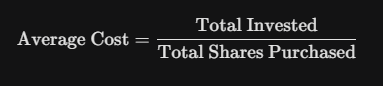
The mathematical beauty of DCA is that it naturally tilts your portfolio toward a better price. Because your fixed dollar amount buys more shares when prices are low, your average cost per share often ends up lower than the average price of the asset over that same period.
The formula for your average cost is:
3. Immediate Entry into the Market
DCA allows you to start building wealth immediately, even if you don’t have a large sum of money. You don’t need $10,000 to start; you can start with $50. This gets the “clock” of compound interest ticking as early as possible.
Dollar-Cost Averaging vs. Lump Sum Investing: The Great Debate
One of the most common questions investors ask is: “If I have a large sum of money right now (like an inheritance or a bonus), should I invest it all at once or spread it out using DCA?”
The Mathematical Reality
Historically, studies (including those by Vanguard) show that Lump Sum Investing beats DCA about 66% of the time. This is because, historically, the stock market spends more time going up than it does going down. By putting your money in all at once, you give it more time to grow.
The Psychological Reality
However, the “best” strategy is the one you can actually stick to. If you invest $100,000 today and the market drops 20% tomorrow, will you panic and sell? If the answer is yes, then DCA is the better choice for you. Spreading that $100,000 over 12 months provides a “safety net” for your ego, ensuring that if the market drops, you’ll feel like you’re getting a bargain on your next purchase rather than losing your shirt.
How to Set Up Your DCA Plan in 5 Simple Steps

Ready to stop worrying about market volatility? Follow these steps to build your own automated wealth machine.
Step 1: Choose Your Investment Vehicle
For most beginners, Low-Cost Index Funds or ETFs (Exchange-Traded Funds) are the best choice. These allow you to own a piece of hundreds of companies at once, which fits perfectly with the DCA philosophy of long-term, diversified growth.
Step 2: Determine Your Frequency
Decide how often you want to invest. Common choices include:
-
Weekly: Good for those who get paid weekly and want to match their cash flow.
-
Bi-Weekly: Often aligns with standard payroll cycles.
-
Monthly: The most popular choice for simplicity and record-keeping.
Step 3: Pick a Fixed Dollar Amount
Look at your budget and decide on an amount you can afford to lose access to for at least 5 to 10 years. Consistency is more important than the size of the check. Even $100 a month can grow into a significant sum over 30 years.
Step 4: Automate the Process
This is the most critical step. Most modern brokerages (like Fidelity, Vanguard, or Schwab) allow you to set up Automatic Investing. This automatically pulls money from your bank account and buys your chosen fund on a specific date. If you have to do it manually, you might “forget” or “wait for a better day,” which ruins the strategy.
Step 5: Review Annually, Not Daily
Once your DCA is running, stop checking the price of your investments every day. Check in once or twice a year to rebalance your portfolio or increase your contribution amount if you’ve received a raise at work.
Advanced Techniques: Value Averaging and Dynamic DCA
Once you are comfortable with basic DCA, you might explore variations that aim to slightly enhance returns.
What is Value Averaging?
Unlike DCA, where you invest a fixed amount of money, Value Averaging involves investing enough to bring your total portfolio value to a certain target.
-
If the market goes up and your portfolio exceeds the target, you invest less.
-
If the market goes down and your portfolio is below the target, you invest significantly more.
While this can result in better returns, it requires much more active management and a larger cash reserve to handle the months when the market drops sharply.
Is Dollar-Cost Averaging Right for Everyone?
While DCA is a powerful tool, it isn’t a magic wand. There are specific scenarios where it might not be the most efficient route.
When DCA is Best:
-
During Bear Markets: If you believe a recession is coming, DCA allows you to “walk down” the stairs with the market, buying cheaper and cheaper shares.
-
For New Investors: If you are just starting your career and investing out of your paycheck, you are naturally doing DCA.
-
For Volatile Assets: DCA is highly effective for assets with high price swings, such as individual tech stocks or cryptocurrencies.
When DCA is Less Effective:
-
In a Consistent Bull Market: If the market only goes up, every day you wait to invest is a day you lose out on gains.
-
If Fees are High: If your brokerage charges a flat fee per trade (e.g., $10 per transaction), doing DCA with small amounts will result in a large percentage of your money going to fees. Note: Most major US brokerages now offer $0 commission trades, making this less of an issue.
Common Misconceptions About Dollar-Cost Averaging

“DCA Guarantees I Won’t Lose Money”
False. DCA reduces the risk of buying at the “top,” but it does not protect you from a permanent loss of capital if the asset you are buying goes to zero. This is why you should only use DCA with diversified funds or high-quality companies.
“I Should Stop DCA When the Market is Crashing”
False. This is the exact opposite of what you should do. The “magic” of DCA happens during the crashes. That is when your fixed dollar amount buys the most shares. If you stop during a crash, you are essentially “buying high and refusing to buy low.”
The Role of DCA in a Balanced Retirement Plan
For most Americans, the 401(k) plan is the ultimate form of Dollar-Cost Averaging. Every payday, a portion of your salary is automatically invested into your retirement funds.
This is why 401(k) investors often wake up after 20 years with hundreds of thousands of dollars. They didn’t “beat the market”—they simply practiced disciplined DCA without even thinking about it. By applying this same logic to your individual brokerage accounts or IRAs, you can accelerate your path to financial independence.
Patience is Your Most Valuable Asset
Dollar-Cost Averaging is more than just a math trick; it is a philosophy of humility. It is an admission that we don’t know what the market will do tomorrow, next week, or next month—and that’s okay.
By embracing the fluctuations of the market rather than fearing them, you turn volatility into your friend. While others are stressing over headlines and flickering red numbers, the DCA investor is quietly accumulating shares, confident that the long-term trajectory of the global economy is upward.
Start your DCA journey today. Set your amount, pick your fund, and let the power of time and consistency do the heavy lifting for you.