Can You Build Wealth with Small Investments?

For decades, a persistent myth has haunted the halls of personal finance: the idea that you need a “small fortune” just to get a seat at the table. Many people believe that unless they have $10,000 or $50,000 sitting in a high-yield account, the stock market is a playground reserved exclusively for the elite.
Here is the truth: Wealth is not built by having money; it is built by having a system.
In the modern financial era, the barriers to entry have crumbled. Thanks to technological shifts and the democratization of finance, you can now start building a legitimate, wealth-generating portfolio with the cost of a single dinner out. In this guide, we will explore the strategies, math, and platforms that prove you can indeed build massive wealth starting with small investments.
The Psychology of Micro-Investing: Why Starting Small is Your Secret Weapon

One of the biggest hurdles to financial freedom isn’t the lack of capital—it’s the “all-or-nothing” fallacy. We tell ourselves, “I’ll start investing when I have a real salary,” or “I’ll wait until I can afford 100 shares of that tech giant.”
By waiting for the “perfect” moment, you lose the one asset that no billionaire can buy back: Time.
Starting small allows you to build the “investor muscle.” When you invest $20 a week, you learn to live on slightly less while watching your assets grow. You become accustomed to market volatility without the heart-stopping stress that comes with managing a six-figure portfolio. By the time you do have larger sums to invest, you already possess the discipline and knowledge required to handle them.
The Mathematics of Wealth: How Compound Interest Rewards the Early, Not Just the Rich
To understand how small amounts turn into fortunes, we have to look at the formula for compound interest. In the world of finance, compounding is the process where your investment’s earnings are reinvested to generate their own earnings.
The formula for compound interest is:
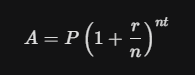
Where:
-
A = the future value of the investment
-
P = the principal investment amount (your small start)
-
r = the annual interest rate (decimal)
-
n = the number of times interest is compounded per year
-
t = the number of years the money is invested
The Power of Time Over Capital
Consider two investors:
-
Investor A starts at age 20, investing just $100 a month at an 8% annual return. By age 65, they have approximately $527,000.
-
Investor B waits until age 40 to start, but they invest $400 a month (four times as much!) at the same 8% return. By age 65, they have only $380,000.
Even though Investor B put in significantly more principal, Investor A ended up with nearly $150,000 more simply because they started small and stayed consistent.
Top Investment Vehicles for Small Capital in 2026
If you only have $5, $50, or $500, where should you put it? The landscape has changed significantly, offering several high-quality options for small-scale investors.
1. Fractional Shares
Traditionally, if a stock like Amazon or Berkshire Hathaway cost thousands of dollars per share, you were locked out. Today, most major brokerages offer fractional shares. This means you can buy $5 worth of a $3,000 stock. You own a tiny slice of the company, and you receive dividends proportional to your ownership.
2. Exchange-Traded Funds (ETFs)
ETFs are collections of stocks or bonds that trade like a single stock. Instead of trying to pick the “next big thing,” you can buy a share of an ETF that tracks the entire S&P 500. This gives you instant diversification across hundreds of companies for a very low price.
3. Micro-Investing Apps
Apps like Acorns or Stash popularized the “round-up” method. These apps link to your debit card, round up your purchases to the nearest dollar, and invest the spare change. While “spare change” sounds insignificant, for a heavy spender, this can result in $30 to $100 of automated investing every month without ever feeling the “pinch” in their budget.
How Technology Democratized the Stock Market: Lowering the Barriers
In the late 90s and early 2000s, every trade you made could cost you $15 to $30 in commissions. For a small investor, this was a death sentence. If you invested $100 and paid a $15 fee, you were immediately down 15% on your investment.
The “Zero-Commission” Revolution
Led by platforms like Robinhood and eventually followed by giants like Charles Schwab and Fidelity, the industry moved to $0 commissions. This is the single most important development for building wealth with small amounts. It means you can invest $10 today and $10 tomorrow without losing a cent to transaction fees.
Key Takeaway: In 2026, there is no longer a “tax on being poor” in the stock market. Every dollar you invest goes directly toward your future.
Finding “Hidden Capital” in Your Daily Budget
Many people claim they don’t have enough money to invest, but often, the capital is hidden in plain sight. This is frequently referred to as the “Latte Factor,” but it applies to any recurring, non-essential expense.
The Impact of Small Savings
| Monthly Savings | Annual Investment | Value After 30 Years (8% Return) |
| $25 (one streaming sub) | $300 | $37,500 |
| $100 (dining out less) | $1,200 | $150,000 |
| $250 (car payment/luxury) | $3,000 | $375,000 |
By cutting just one or two small expenses and redirecting that cash into a brokerage account, you aren’t just saving money—you are purchasing your future freedom.
Best Platforms and Apps for Small-Scale Investing
When choosing a platform for small investments, you should look for three things: No account minimums, zero commissions, and fractional share support.
-
Fidelity: Often cited as the best all-around brokerage. They offer “Fidelity Spire” and fractional shares (called Stocks by the Slice) with no minimums.
-
Vanguard: While historically for larger investors, their move into low-cost ETFs has made them accessible to everyone.
-
Robinhood/Webull: Great for mobile-first users who want a simple interface and the ability to buy tiny amounts of crypto or stocks.
-
Betterment/Wealthfront: These are “Robo-Advisors.” You tell them your goals, and they automatically invest your small contributions into a diversified portfolio for a small annual fee.
Strategic Asset Allocation for Small Portfolios

Just because your portfolio is small doesn’t mean it should be reckless. A common mistake beginners make is taking “penny stock” gambles because they feel $100 isn’t enough to make a difference in a stable company.
The “Core and Satellite” Strategy
A smarter approach is to put 80% of your small investment into a Core (like a Total World Stock Market ETF). This ensures you grow with the global economy. Use the remaining 20% as a Satellite to invest in individual companies or sectors you are passionate about. This keeps you engaged without risking your entire foundation on a single “moonshot” bet.
Real Estate for the “Little Guy”: Can You Invest with $100?
For a long time, real estate was the ultimate “big money” game. You needed a down payment, a mortgage, and a lawyer.
Enter Real Estate Crowdfunding
Platforms like Fundrise or RealtyMogul allow you to invest in large-scale commercial or residential real estate projects with as little as $10 to $100. You become a mini-landlord, earning a share of the rental income and the property’s appreciation. While these investments are less “liquid” (meaning you can’t sell them as easily as a stock), they provide a great way to diversify a small portfolio.
Common Pitfalls to Avoid When Investing Small Amounts
-
Over-Trading: Because it’s “only $20,” you might be tempted to jump in and out of stocks. Constant trading usually leads to losses and taxes.
-
Neglecting the Emergency Fund: Never invest money you might need for rent next month. Investing is for “long-term” money. Ensure you have a small cash cushion before you start.
-
Falling for “Get Rich Quick” Schemes: If an investment promises to turn your $100 into $10,000 in a month, it’s likely a scam or a high-risk gamble. Real wealth building is slow and steady.
-
Ignoring Taxes: Even small gains are taxable. If you are in the US, consider using a Roth IRA. In a Roth IRA, you invest “after-tax” money, but all the growth and future withdrawals are 100% tax-free. This is the ultimate “wealth hack” for small investors.
The Role of Education as a High-ROI Investment
When you have a small amount of money, the best “return on investment” might not be in the stock market—it might be in yourself.
If you have $500, buying a certification or a course that helps you earn an extra $5,000 a year is a 1,000% return. Increasing your “earning power” allows you to increase the size of your “small investments” over time. The goal is to start small today so that you can invest large amounts tomorrow.
The Best Time to Plant the Tree was 20 Years Ago

The answer to “Can you build wealth with small investments?” is a resounding yes. But there is a catch: you must be patient. Small investments are like seeds. They don’t become oaks overnight. They require the “water” of consistency and the “sunlight” of time.
Stop waiting for a windfall. Stop waiting for the market to “crash” so you can enter. The most successful investors in the world didn’t start with millions; they started with a habit. Pick a platform, set up a recurring $20 investment, and let the incredible power of the global economy work for you. Your future self will thank you for starting today.