What are index funds?

For the average person, the world of investing often feels like a high-stakes poker game played in a room full of geniuses. We hear stories of “stock pickers” who strike it rich and “market gurus” who claim to know exactly when the next crash is coming. This creates a barrier of fear: if I don’t have the time to research every company or the brainpower to predict the economy, can I still build wealth?
The answer is a resounding yes, thanks to a revolutionary financial tool called the Index Fund.
Index funds have democratized wealth building. They moved investing away from “beating the market” and toward “owning the market.” In this guide, we will explore everything you need to know about index funds, why they are the preferred choice for legendary investors like Warren Buffett, and how they can help you achieve financial independence with minimal effort.
Understanding the Basics: What is a Market Index?
Before we can define an index fund, we must understand what an “index” is. In the financial world, an index is essentially a mathematical yardstick. It is a list of stocks or bonds used to track the performance of a specific segment of the market.
Think of an index like a “bucket” of companies. Instead of looking at how one single company like Apple is doing, an index looks at a group of companies to see how the overall economy or a specific industry is performing.
Famous Indices You Should Know:
-
The S&P 500: This is the most famous index. It tracks 500 of the largest, most successful companies in the United States. When people say “the market is up today,” they are usually talking about the S&P 500.
-
The Dow Jones Industrial Average (DJIA): A smaller index that tracks 30 massive “blue-chip” companies.
-
The Nasdaq Composite: An index heavily weighted toward technology and growth companies.
-
The Russell 2000: An index that tracks smaller, “small-cap” companies in the U.S.
An Index Fund is simply a mutual fund or an ETF (Exchange-Traded Fund) that buys all the stocks listed in a specific index. If you buy an S&P 500 index fund, you are literally buying a small piece of all 500 companies in that list.
Active vs. Passive Management: Why “Boring” Investing Wins
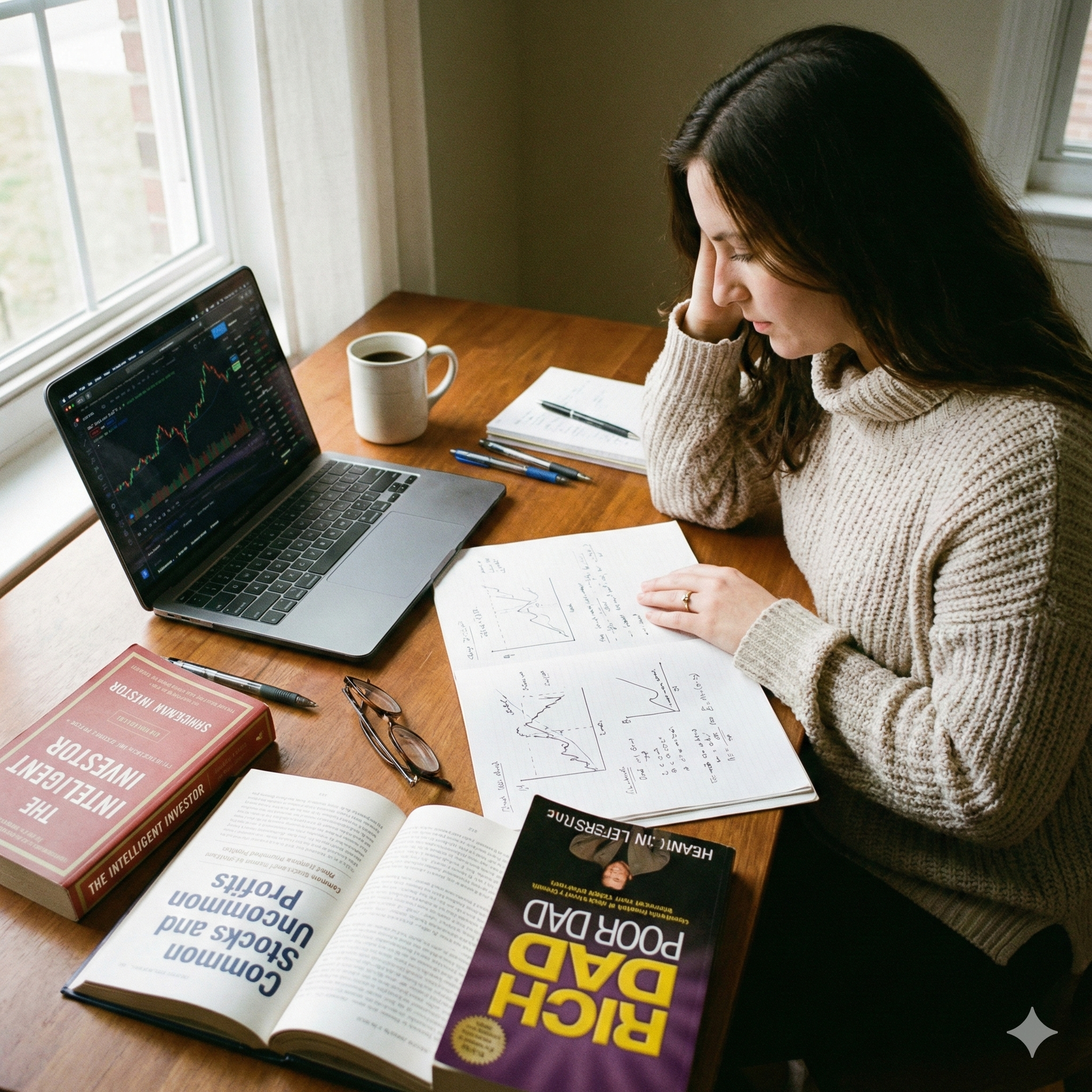
To understand why index funds are so powerful, you have to understand the battle between Active and Passive management.
Active Management
In an active fund, a professional fund manager (or a team of them) tries to “beat the market.” They spend all day researching, buying, and selling stocks, trying to pick the winners and avoid the losers.
-
The Downside: Research and constant trading are expensive. Active funds charge high fees (expense ratios) to pay the managers. Furthermore, data shows that over long periods, over 90% of active managers actually fail to beat the simple S&P 500 index.
Passive Management (Index Funds)
An index fund is “passive.” There is no genius manager trying to outsmart the market. The fund simply uses a computer program to buy whatever is in the index. If a company joins the S&P 500, the fund buys it. If a company leaves, the fund sells it.
-
The Upside: Because there are no high-priced managers to pay and very little trading, the fees are incredibly low. You get the exact return of the market, which—historically—is better than what most “pros” achieve.
The Power of Instant Diversification
One of the biggest risks in investing is “concentration risk.” If you put all your money into one stock and that company goes bankrupt, you lose everything.
Index funds solve this through instant diversification. When you buy a Total Stock Market Index Fund, you aren’t betting on one company; you are betting on the entire economy. For a company like Apple or Amazon to fail would be a tragedy, but for all 500 or 3,000 companies in an index to fail simultaneously, the world would essentially have to end.
By owning a little bit of everything, you protect yourself. If 10 companies in the index have a terrible year, their losses are usually offset by the 490 other companies that had a good or average year.
Why Low Expense Ratios are Your Secret Weapon
In the world of investing, you get what you don’t pay for. Every mutual fund or ETF charges an Expense Ratio—an annual fee taken as a percentage of your investment.
While 1% might not sound like much, the “magic” of compound interest works both ways. Fees compound too.
-
Active Fund Fee: 1.0% to 1.5%
-
Index Fund Fee: 0.03% to 0.05%
If you invest $100,000 over 30 years with a 7% return:
-
With a 0.05% fee, you would end up with approximately $749,000.
-
With a 1.50% fee, you would end up with approximately $498,000.
That “small” fee difference cost you $251,000 in potential wealth. Index funds allow you to keep nearly all of your gains, rather than giving them away to a middleman.
Tax Efficiency: How Index Funds Save You Money in April
Beyond low fees, index funds are generally more tax-efficient than active funds.
Because active managers trade stocks frequently, they trigger “capital gains taxes” every time they sell a stock for a profit. Even if you don’t sell your shares in the fund, the fund passes those tax bills onto you at the end of the year.
Index funds rarely trade. They only sell a stock if it is removed from the index. This means fewer “taxable events,” allowing your money to grow undisturbed for decades. This is particularly beneficial if you are investing in a standard brokerage account rather than a tax-advantaged account like a 401(k) or IRA.
Different Flavors of Index Funds: ETFs vs. Mutual Funds

When you go to buy an index fund, you will usually see two options: Exchange-Traded Funds (ETFs) and Index Mutual Funds. Both track an index, but they behave differently.
1. Index Mutual Funds
-
Trading: You can only buy or sell them once a day, at the end of the market day.
-
Minimums: Often require an initial investment (e.g., $3,000).
-
Automatic Investing: Great for people who want to set up an automatic “pull” from their bank account every payday.
2. ETFs (Exchange-Traded Funds)
-
Trading: They trade like stocks. You can buy or sell them any time the market is open.
-
Minimums: Usually, the “minimum” is just the price of one single share (sometimes as low as $50 or $100).
-
Efficiency: Slightly more tax-efficient than mutual funds due to the way shares are created and redeemed.
For most long-term investors, the choice doesn’t matter as much as the Expense Ratio. Pick the one with the lowest cost.
The “Big Three” of Index Investing: Vanguard, BlackRock, and Fidelity
If you are looking for the best index funds, you will likely encounter three giant companies that dominate the space. These firms are known for having the lowest fees and the most reliable tracking.
-
Vanguard: Founded by John Bogle, the “father” of the index fund. Vanguard is unique because it is owned by its funds, meaning the investors are the owners.
-
BlackRock (iShares): The largest asset manager in the world, offering a massive variety of low-cost ETFs.
-
Fidelity: A long-time leader that recently made waves by offering “Zero Expense Ratio” funds (funds that literally cost $0 in fees).
How to Build a Simple “Three-Fund Portfolio”
You don’t need a complex strategy to succeed. Many of the most successful retail investors use what is called the Three-Fund Portfolio. This provides total global diversification with just three clicks:
-
Total U.S. Stock Market Index: Covers every public company in the United States.
-
Total International Stock Market Index: Covers companies in Europe, Asia, and emerging markets.
-
Total Bond Market Index: Provides stability and pays interest, acting as a cushion when the stock market is volatile.
By adjusting the percentages of these three funds, you can create a portfolio that matches your age and risk tolerance.
The Risks of Index Funds: What You Need to Know

While I am a huge advocate for index funds, it is important to be a realistic investor. Index funds are not “risk-free.”
-
Market Risk: An index fund will go down if the market goes down. If the S&P 500 drops 20%, your S&P 500 index fund will also drop 20%. It does not protect you from a recession.
-
No “Alpha”: You will never “beat” the market. You will never find the next “Amazon” early and make 10,000% returns on a single stock. You are settling for the average. (Though, as we’ve seen, the “average” is actually better than what most experts achieve).
-
Concentration in Top Stocks: Many indices are “market-cap weighted.” This means the biggest companies (like Microsoft, Apple, and Nvidia) make up a huge percentage of the fund. If those few companies struggle, the whole index can suffer.
Step-by-Step: How to Start Investing in Index Funds Today
Ready to put your money to work? Here is the simple path:
-
Open a Brokerage Account: Use a reputable firm like Vanguard, Fidelity, Charles Schwab, or Robinhood.
-
Choose Your Index: For most, a “Total Stock Market” or “S&P 500” index is the best starting point.
-
Check the Expense Ratio: Ensure the fee is below 0.10%.
-
Set Up Automatic Contributions: Consistency is more important than the amount. Even $50 a month creates a habit.
-
Leave It Alone: The biggest mistake investors make is checking their balance every day and selling when things look scary.
The Philosophy of Enough
Index investing is more than just a financial strategy; it’s a philosophy. It’s an admission that we don’t know everything, and that we don’t need to be “smarter” than everyone else to be wealthy.
By choosing index funds, you are choosing to spend your time living your life—focusing on your career, your family, and your hobbies—while the greatest companies in the world work for you in the background. It is the ultimate “set it and forget it” path to financial freedom.
Start today, keep your costs low, and let time do the heavy lifting. Your future self will thank you.