How Much Bitcoin Can You Buy With $100, $500, or $1,000?
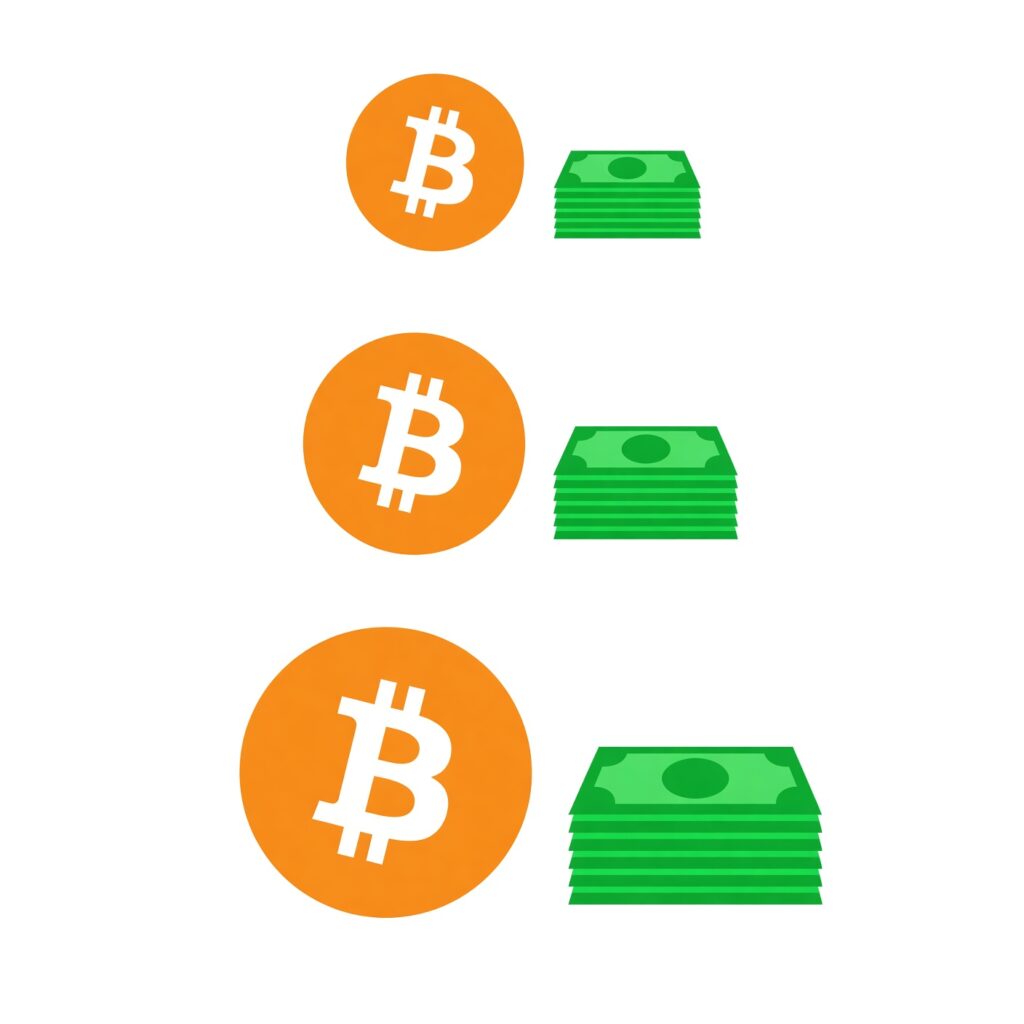
image for illustrative purposes only.
Understanding Bitcoin Divisibility: The Power of Satoshis
Before analyzing specific dollar amounts, it is essential to understand how Bitcoin is measured. Unlike traditional fiat currencies where the smallest unit is typically one cent (one-hundredth of a dollar), Bitcoin is infinitely more divisible.
The base unit of Bitcoin can be broken down into eight decimal places. The smallest possible unit of Bitcoin is called a Satoshi (named after the pseudonymous creator, Satoshi Nakamoto).
- 1 Bitcoin (BTC) = 100,000,000 Satoshis
- 0.1 BTC = 10,000,000 Satoshis
- 0.01 BTC (often called a “bit”) = 1,000,000 Satoshis
- 0.001 BTC = 100,000 Satoshis
This granular divisibility ensures that Bitcoin functions effectively as a global medium of exchange and a unit of account. Even if the price of a single coin climbs to extraordinary heights, anyone with a smartphone and a few spare dollars can own a measurable share of the network. When you buy cryptocurrency on an exchange, you are rarely purchasing a whole coin; instead, you are accumulating Satoshis. Keeping this perspective changes how you view a $100 or $500 investment, turning what might feel like a negligible amount into a substantial accumulation of individual satoshis.
What Can You Buy With $100? The Micro-Investment Approach
Starting your crypto journey with a $100 bill is one of the most popular ways for beginners to test the waters without exposing themselves to high psychological or financial pressure. It is an amount low enough that losing it would not disrupt your livelihood, yet substantial enough to experience real-time market volatility, learn how exchange interfaces work, and understand self-custody.
Calculating Your Return
To figure out how much Bitcoin $100 buys, you must divide your investment by the current market price of Bitcoin. For the sake of illustration, let us assume Bitcoin is trading at a baseline price of $60,000 per coin.
Bitcoin Acquired = $100 / $60,000 ≈ 0.00166667 BTC
Expressed in Satoshis, a $100 investment at a $60,000 valuation yields roughly 166,667 Satoshis.
If the market price fluctuates to $70,000, that same $100 yields approximately 142,857 Satoshis. Conversely, if a market correction drops the price to $50,000, your $100 captures 200,000 Satoshis.
Strategic Value and Psychological Benefits
While holding a fraction of a percent of a whole coin might feel insignificant at first glance, micro-investments serve a vital educational purpose.
- Risk Mitigation: You limit your downside exposure while learning the mechanics of market charts, order books, and blockchain network fees.
- Habit Formation: Committing $100 regularly helps build the discipline necessary for long-term wealth accumulation through strategies like dollar-cost averaging.
- Operational Familiarity: Moving $100 worth of crypto from an exchange to a personal software wallet teaches you about public keys, private keys, and transaction fees without risking significant capital.
Scaling Up: What Can You Buy With $500?
Stepping up to a $500 investment shifts your posture from casual experimentation to intentional capital allocation. At this level, investors often start treating digital assets as a serious component of a diversified portfolio rather than a casual novelty.
Mathematical Breakdown
At a benchmark price of $60,000 per Bitcoin, a $500 allocation scales your purchasing power linearly:
Bitcoin Acquired = $500 / $60,000 ≈ 0.00833333 BTC
This translates to 833,333 Satoshis—pushing you significantly closer to owning a full percentage point (0.01 BTC) of a whole coin.
Portfolio Integration and Risk Management
With $500 deployed into the market, fee management becomes a critical factor in your overall return. On many centralized exchanges, percentage-based trading fees, fixed withdrawal fees, and network mining fees can eat into a smaller balance more aggressively than a larger one.
- Minimizing Exchange Friction: Look for platforms offering low maker-taker fees or instant purchase options with transparent pricing. A high flat fee on a $500 transaction can immediately erase a fraction of your gains.
- Asset Allocation: For an investor with a total net investable capital of $5,000, a $500 allocation represents a 10% exposure to digital assets. This is a common threshold for traditional financial advisors looking to balance high-growth, high-volatility assets with more stable equities and fixed-income products.
- Tracking Performance: At this level, utilizing a dedicated portfolio tracker helps you monitor cost basis, break-even points, and asset performance across different market cycles without getting overwhelmed by daily noise.
Entering the Four-Figure Club: What Can You Buy With $1,000?

Allocating $1,000 to a single digital asset is a psychological milestone for many retail participants. It represents a commitment to the thesis of decentralized, scarce digital money and often forces investors to take security and storage much more seriously.
The Numbers Behind the Capital
Using our standard benchmark of $60,000 per Bitcoin, a $1,000 deployment yields:
Bitcoin Acquired = $1,000 / $60,000 ≈ 0.01666667 BTC
This gives you 1,666,667 Satoshis, moving you well past the 0.01 BTC milestone. In a theoretical scenario where Bitcoin reaches $100,000 per coin, your initial $1,000 investment would grow in nominal value to roughly $1,666.
Security and Custody Considerations
When the capital on an exchange reaches or exceeds $1,000, leaving those funds sitting passively on a trading platform becomes an unnecessary risk. Centralized platforms are perpetual targets for hackers, regulatory shifts, and internal insolvency issues. Transitioning from exchange custody to self-custody becomes paramount.
- Software Wallets (Hot Wallets): Applications on your mobile phone or desktop give you direct control over your private keys. They are convenient for intermediate users managing amounts like $1,000, provided you securely back up your seed phrase offline.
- Hardware Wallets (Cold Storage): For many, hitting the $1,000 mark is the exact tipping point where purchasing a dedicated hardware device (a physical offline crypto vault) makes rational sense. Securing 1.6 million Satoshis on an air-gapped device ensures protection against remote malware and browser-based exploits.
The Macroeconomic Context: Why Scarcity Matters
To truly appreciate what $100, $500, or $1,000 buys you today, you have to look beyond the spot price and examine the underlying economic design of Bitcoin. Traditional fiat currencies—such as the US Dollar, Euro, or Yen—suffer from perpetual expansion. Central banks can, and frequently do, print more currency to stimulate economies, service debt, or respond to financial crises. This monetary expansion leads directly to currency devaluation and consumer price inflation over time.
Bitcoin operates on the exact opposite economic model.
A Fixed Supply Cap
The total supply of Bitcoin is hard-coded into its core software protocol at 21 million coins. No government, corporation, or developer can alter this parameter. Furthermore, the rate at which new Bitcoin is created is cut in half roughly every four years through an event known as the “halving.”
- Predictable Issuance: As new supply slows down while global demand fluctuates or increases, the economic dynamics of scarcity take over.
- Long-Term Purchasing Power: When you buy 166,000 Satoshis with your $100 today, you are locking in a permanent, un-dilutable slice of a total finite supply. No entity can ever create a 21 million and first Bitcoin.
This mathematical scarcity is the primary reason long-term holders view digital assets as a hedge against systemic monetary debasement. While fiat money loses purchasing power in your bank account due to inflation, a fixed supply asset maintains its structural rarity regardless of macroeconomic policy shifts.
Tactical Strategies for Deploying Your Capital
Simply deciding to invest $100, $500, or $1,000 is only half the battle. How you execute the purchase can dramatically impact your average entry price and your overall peace of mind. Markets are notoriously cyclical and prone to sharp, emotional swings. Choosing the right acquisition method helps mitigate the anxiety of bad timing.
1. Lump-Sum Investing
Deploying your entire capital amount all at once is known as a lump-sum strategy.
- The Pros: Historically, in upward-trending markets, getting your money into the market as fast as possible yields higher returns because the asset has more time to compound and appreciate.
- The Cons: If you deploy $1,000 into Bitcoin on a local market peak, you immediately experience a psychological drawdown if the price corrects by 20% or 30% the following week. This can induce panic selling among inexperienced participants.
2. Dollar-Cost Averaging (DCA)
Dollar-cost averaging involves splitting your total intended investment into smaller, equal chunks and purchasing at regular, predetermined intervals—regardless of the asset’s price.
- How it works with a $500 budget: Instead of buying $500 worth of Bitcoin on a single Tuesday afternoon, you might purchase $100 worth every week for five consecutive weeks, or $50 every week for ten weeks.
- The Pros: DCA completely removes the emotional burden of trying to “time the market.” When prices drop, your fixed dollar amount buys more Satoshis; when prices rise, it buys fewer. This automatically lowers your average cost basis over time and cushions the blow of short-term volatility.
- The Cons: In a fiercely raging bull market where prices march upward in a straight line, lump-sum investing generally outperforms DCA because you bought earlier at lower prices.
Common Pitfalls to Avoid When Buying Crypto

Navigating digital asset exchanges for the first time can expose you to unnecessary costs and security vulnerabilities if you are not careful. Keeping a few core principles in mind will protect your capital from avoidable mistakes.
Ignoring Transaction and Network Fees
Many beginners make the mistake of looking only at the spot price of Bitcoin while ignoring the friction costs associated with moving funds.
- Card Processing Fees: Buying crypto via credit or debit card on an exchange often incurs higher fees (sometimes 3% to 5%) compared to depositing funds via an automated clearing house (ACH) bank transfer or wire transfer.
- Withdrawal Costs: If you purchase $100 worth of Bitcoin on an exchange and immediately withdraw it to a private wallet, a static network mining fee might take a noticeable bite out of your total balance. Always check exchange withdrawal policies before moving small amounts of capital.
Falling for FOMO and Emotional Trading
The media loves sensationalizing both extreme market crashes and explosive bull runs. Seeing headlines about rapid price surges often triggers Fear Of Missing Out (FOMO), causing investors to deploy capital recklessly at local cycle tops. Conversely, sharp market corrections can induce panic, leading people to sell their Satoshis at a loss. Sticking to a predefined budget—whether it is $100, $500, or $1,000—and a disciplined purchasing plan helps inoculate you against emotional decision-making.
The amount of Bitcoin you can buy with $100, $500, or $1,000 ultimately matters far less than the mindset and strategy you bring to the table. Because Bitcoin is infinitely divisible into Satoshis, wealth accumulation in the digital asset space is not reserved exclusively for institutional giants or high-net-worth individuals.
Whether you start small with a $100 micro-investment to learn the ropes, commit $500 to build a balanced portfolio allocation, or secure $1,000 worth of scarce digital property backed by self-custody, every single Satoshi counts. By understanding the mechanics of fractional units, appreciating the macroeconomic reality of a fixed 21-million supply cap, and employing disciplined purchasing strategies like dollar-cost averaging, you position yourself to navigate the evolving digital economy with confidence, clarity, and control.