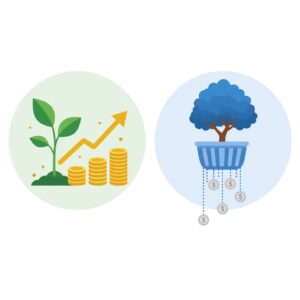
The Difference Between Investing for Growth and Investing for Income
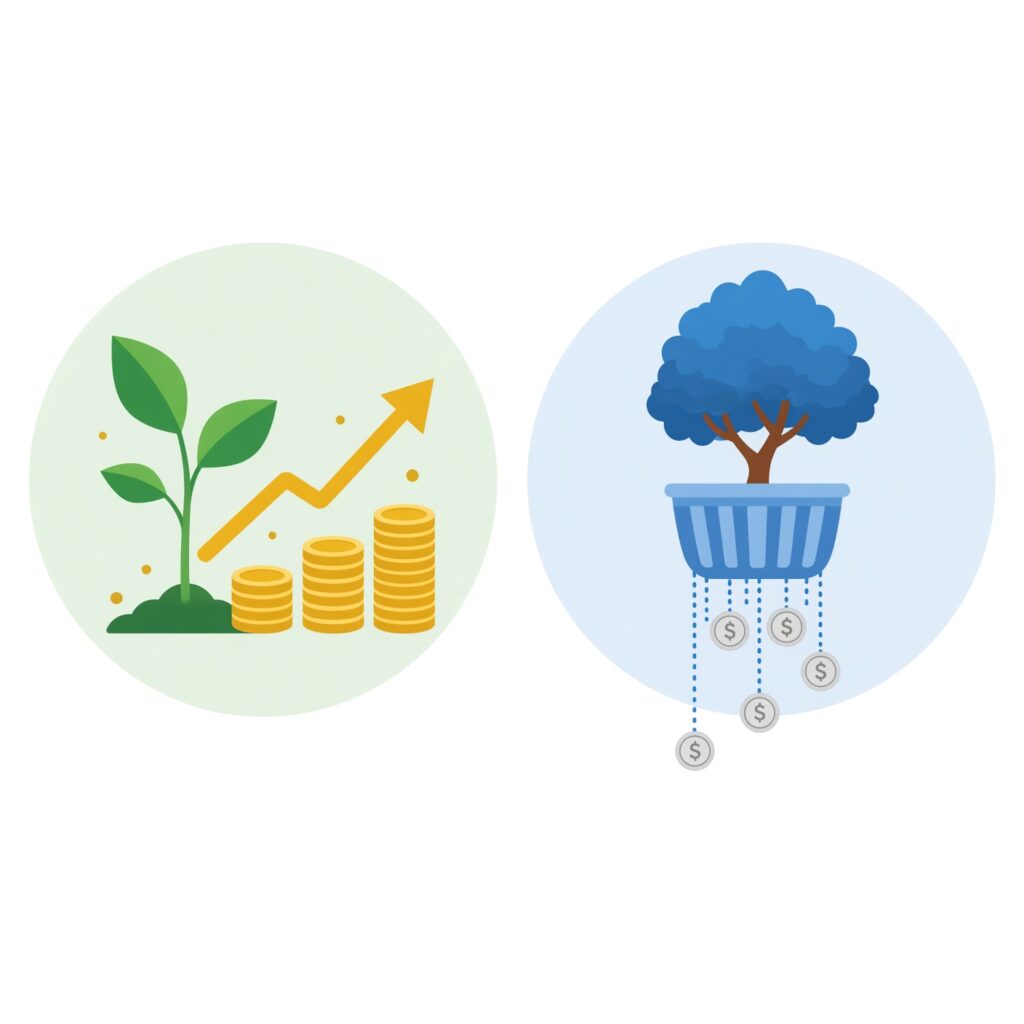
image for illustrative purposes only.
When you first step into the world of personal finance and portfolio management, one of the most fundamental choices you will face is determining the primary objective of your capital. Every dollar you allocate to the markets must ultimately serve a distinct purpose. For most individuals, that purpose boils down to two classic strategies: building wealth for the future or generating cash flow for the present.
Understanding the mechanics, risks, and strategic applications of these two distinct paths is vital for anyone looking to build a resilient financial foundation. While they are often presented as opposing philosophies, growth investing and income investing represent two sides of the same coin. Exploring how they work, how they differ, and how they can be harmonized will allow you to construct a portfolio tailored precisely to your long-term ambitions.
What Is Growth Investing?

Growth investing is a strategy focused primarily on capital appreciation. The core objective here is to increase the total value of your investment portfolio over an extended period. Rather than looking for regular cash distributions, growth investors seek out companies, sectors, or assets that exhibit strong potential to expand their revenues and earnings at a pace significantly faster than the broader market.
When a company is in a heavy growth phase, management rarely distributes its profits back to shareholders in the form of cash dividends. Instead, the leadership team chooses to retain those earnings, plowing them directly back into the enterprise. This capital is typically used to fund research and development, expand operations, acquire emerging competitors, or scale technological infrastructure.
By reinvesting earnings internally, the company aims to accelerate its expansion. In theory, this continuous business momentum translates directly into a higher stock valuation over time, rewarding shareholders through substantial capital gains when they eventually decide to liquidate their positions.
Common Characteristics of Growth Assets
Growth-oriented opportunities are most commonly found in dynamic sectors where innovation and disruption drive rapid expansion. Technology firms, consumer discretionary companies, biotechnology pioneers, and emerging market equities frequently populate a growth-focused portfolio.
Additionally, alternative asset classes—such as residential real estate purchased primarily for market appreciation rather than rental yield—share similar attributes. These assets are characterized by their capacity for exponential scaling, though this potential is almost always accompanied by a higher degree of short-term price volatility.
What Is Income Investing?
In stark contrast to the capital appreciation focus of growth strategies, income investing prioritizes the generation of steady, reliable cash flow. The primary objective for an income-focused investor is not necessarily watching the underlying asset price skyrocket, but rather collecting regular, predictable payouts that can be utilized immediately or redirected elsewhere.
Income investing treats a portfolio like an active cash machine. Instead of relying on selling shares to realize gains, an income investor harvests the dividends, interest payments, or distributions thrown off by the assets they hold. This cash flow acts as a supplementary layer of financial stability, functioning much like a secondary stream of earnings.
Companies that anchor income portfolios are typically mature, well-established businesses with predictable cash flows and dominant market positions. Because these corporations have already moved past their hyper-expansion phases, they do not require every dollar of profit for internal reinvestment. Consequently, they return a significant portion of their earnings directly to their investors via regular dividend payouts.
Common Characteristics of Income Assets
The universe of income-producing assets spans several distinct categories, each offering unique risk and reward dynamics:
-
Dividend-Paying Equities: Shares of stable, large-cap corporations—often found in sectors like utilities, consumer staples, telecommunications, and financial services—that boast long histories of maintaining or increasing their dividend distributions.
-
Fixed-Income Securities: Government bonds, municipal bonds, and corporate debt instruments that pay regular coupon interest over a specified maturity schedule.
-
Income-Focused Funds: Mutual funds, exchange-traded funds (ETFs), and real estate investment trusts (REITs) specifically structured to pool capital and distribute regular yields to shareholders.
Core Differences Between Growth and Income Strategies
While both approaches aim to build financial security, they diverge significantly across several operational dimensions. Recognizing these structural variations helps clarify why an investor might lean toward one strategy over the other depending on their station in life.
Time Horizon and Compounding
The most foundational distinction between the two approaches is timing. Growth investing is inherently a long-term play. It relies heavily on the power of compounding over decades, requiring investors to leave their capital untouched so that unrealized gains can build upon themselves.
Income investing, conversely, provides tangible utility much sooner. Because cash payouts are delivered at regular intervals throughout the year, investors can access liquidity without having to sell off their underlying ownership stakes.
Volatility and Risk Tolerance
Growth assets are notorious for their price swings. A high-growth technology stock may experience dramatic surges during bull markets, only to suffer sharp pullbacks during periods of economic uncertainty. Investors pursuing growth must possess a high tolerance for volatility and the psychological fortitude to ride out multi-year market downturns.
Income assets, particularly high-grade fixed income and defensive dividend stocks, generally exhibit lower price volatility. The emphasis here is on capital preservation and downside protection. While these assets may not match the explosive upside of growth equities, their steady cash distributions help cushion the portfolio against market turbulence.
Evaluating Your Personal Timeline and Risk Profile

Choosing between these two methodologies requires an honest assessment of your current life stage, financial obligations, and emotional comfort with market risk.
Investors who are early in their professional careers or decades away from retirement typically lean heavily toward a growth-oriented approach. With a multi-decade time horizon ahead, short-term market corrections matter far less than the long-term compounding potential of equities. They have the luxury of time, allowing them to absorb volatility in exchange for maximized capital accumulation.
On the other hand, individuals who are approaching retirement or have already exited the traditional workforce often find themselves prioritizing income. When regular salary contributions cease, replacing that active income with reliable portfolio cash flow becomes paramount. At this stage, protecting the principal while ensuring consistent liquidity takes center stage over chasing speculative upside.
The Power of a Blended Portfolio Approach
Despite the distinct philosophies separating growth from income, modern portfolio theory demonstrates that investors do not necessarily need to choose an absolute binary path. In practice, many successful long-term investors adopt a hybrid strategy, combining elements of both approaches to create a balanced financial engine.
A blended portfolio allows you to harness the wealth-building capabilities of growth assets while simultaneously enjoying the stabilizing cash flow of income-producing securities. For example, a core holding of broad-market index funds or growth-oriented ETFs can be paired with dividend-paying equities and high-quality bond funds.
This hybrid construction creates a natural internal ecosystem: the growth portion works diligently to expand your net worth over the long haul, while the income portion softens portfolio volatility and provides immediate liquidity. Furthermore, as your life circumstances evolve, the weighting between these two components can be dynamically adjusted—gradually tilting away from aggressive growth and toward reliable income as your financial priorities shift over the years.
Ultimately, successful investing is not about finding a universal “best” strategy, but rather about aligning your portfolio structure with your unique personal objectives. By carefully evaluating your time horizon, cash flow needs, and risk tolerance, you can intentionally design a strategy that serves your financial future precisely the way you intend.