What Happens If You Invest $500 Every Month for 10 Years?
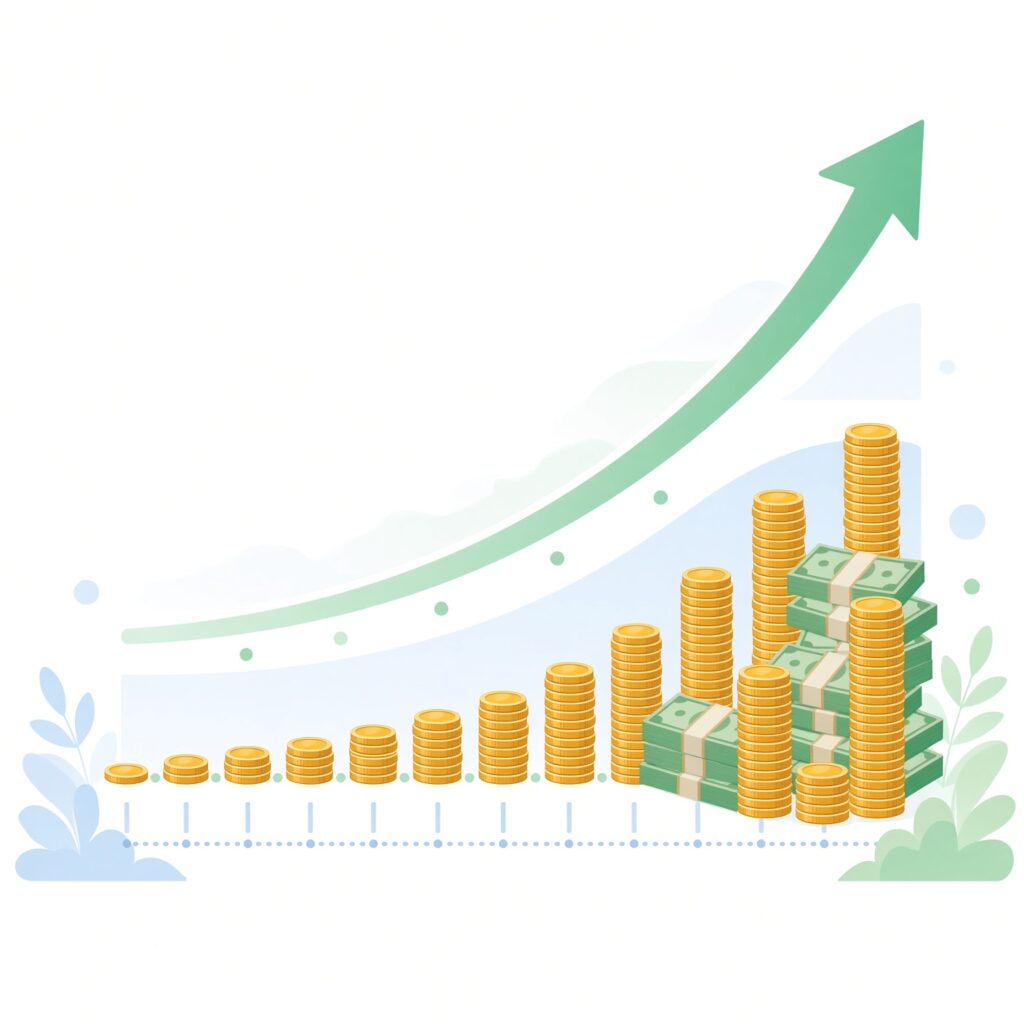
image for illustrative purposes only.
Building long-term wealth often feels like an impossible puzzle when you look at the massive net worth figures tossed around in financial media. Many beginners assume that achieving financial security requires a six-figure inheritance, a high-stakes corporate bonus, or risky bets on speculative assets. However, the true engine of wealth creation is much simpler, much quieter, and entirely accessible to the disciplined saver: consistent, automated, long-term investing.
If you commit to setting aside $500 every single month and putting that money to work in the markets, what does your financial landscape look like a decade down the road? The answer is a powerful testament to the mathematical mechanics of compound interest and systematic execution. This comprehensive guide breaks down the numbers, the strategies, the behavioral traps, and the mathematical reality of investing $500 monthly for ten years.
The Power of Consistent Accumulation: Breaking Down the Numbers

Before diving into market returns and compound growth, it is essential to look at the raw, uninvested principal. Saving $500 every month is a tangible goal for many middle-income earners who audit their monthly cash flow, trim unnecessary subscriptions, and prioritize automated savings. Over the course of ten years, your timeline looks like this:
- Monthly Contribution: $500
- Annual Contribution: $6,000
- Total Timeline: 10 Years (120 Months)
- Total Out-of-Pocket Principal Invested: $60,000
Stashing $60,000 in a traditional, low-yield savings account or a checking account over a decade provides absolute safety against market downturns, but it leaves you intensely vulnerable to a silent wealth killer: inflation. Cash sitting idle loses purchasing power year after year. To make your money grow, it must be deployed into income-generating assets, growth equities, or diversified market funds.
How Compound Interest Transforms Your $500 Monthly Contributions
Albert Einstein famously (though perhaps apocryphally) called compound interest the eighth wonder of the world. In the context of monthly investing, compounding means that your money earns returns, and then those returns earn their own returns, creating a snowball effect that accelerates over time.
To understand what happens when you invest $500 every month for 10 years, we have to look at historical stock market averages. Over long periods, the broad U.S. stock market—often measured by indices like the S&P 500—has historically delivered an average annualized return of roughly 7% to 10% after adjusting for inflation, or around 10% in nominal terms. Let us examine three different growth scenarios assuming a steady monthly contribution of $500 over a 120-month horizon:
- Conservative Scenario (6% Annual Return): At a modest 6% return, your total portfolio value after 10 years grows to approximately $82,274. Your net profit from market gains alone sits at over $22,000, purely from letting your money work for you.
- Moderate Historical Scenario (8% Annual Return): Assuming an 8% annualized return, your total portfolio swells to roughly $91,473. At this stage, your compound growth is generating nearly $31,500 in earnings on top of your $60,000 principal.
- Aggressive Historical Scenario (10% Annual Return): If the market performs near its stronger historical averages with a 10% annual return, your portfolio reaches approximately $101,929. You cross the coveted six-figure milestone, with more than $41,900 generated entirely through compound growth.
Notice how the gap between your total principal ($60,000) and your final portfolio value widens significantly the higher the return and the longer the capital stays invested. This acceleration is the hallmark of compounding.
The Mechanics of Dollar-Cost Averaging (DCA)
One of the greatest psychological barriers for new investors is market timing. People constantly worry about putting their money into the market right before a major crash, a correction, or a prolonged bear market. However, when you invest $500 every single month, you naturally utilize a legendary wealth-building strategy known as Dollar-Cost Averaging (DCA).
Dollar-cost averaging eliminates the stress of timing the market. By contributing a fixed dollar amount on a predetermined schedule—regardless of whether the market is up, down, or sideways—you automatically buy more shares when prices are low and fewer shares when prices are high. Think of it like buying groceries: when your favorite coffee goes on sale, you get more boxes for your money; when the price goes up, you buy less. Over a 10-year period, DCA lowers your average cost per share and protects you from the emotional paralysis of trying to find the absolute “bottom” of the market.
Where Should You Allocate Your $500 Monthly Investment?
Accumulating capital is only half the battle; deciding where to direct those funds dictates your risk profile, tax efficiency, and ultimate return. While individual stock picking can yield massive winners, it also exposes everyday investors to catastrophic single-stock risk. For a disciplined 10-year wealth-building strategy, consider the following diversified asset classes and vehicles:
1. Broad-Market Index Funds and Exchange-Traded Funds (ETFs)
For the vast majority of investors, low-cost index funds tracking the total stock market or the S&P 500 represent the gold standard of investing. When you purchase an index fund with your $500, you instantly buy tiny fractional slices of hundreds of top-tier corporations. This built-in diversification ensures that the failure or underperformance of a single company will not sink your financial goals.
2. Dividend Growth Portfolios
If your strategy leans toward generating passive income, directing your monthly contributions toward dividend-paying stocks or dividend appreciation ETFs can be immensely rewarding. Companies with decades of uninterrupted dividend growth provide regular cash payouts. When you set your account to automatically reinvest those dividends (Dividend Reinvestment Plans or DRIPs), you buy more shares automatically, supercharging your compounding curve over that 10-year window.
3. Tax-Advantaged Accounts
Maximizing the tax efficiency of your $500 monthly investment can dramatically change your net outcome. Utilizing tax-advantaged retirement accounts or flexible brokerage accounts depending on your specific timeline ensures that capital gains and dividends are shielded from heavy taxation, allowing your money to compound at maximum velocity.
The Psychology of Wealth: Consistency Over Intensity

Personal finance is far more psychological than it is mathematical. Anyone can plug numbers into an online compound interest calculator; the true challenge lies in sticking to the plan when life throws curveballs your way.
Over a 10-year span, you will undoubtedly experience economic recessions, bear markets, job changes, inflation spikes, and personal financial emergencies. During a severe market crash, your $100,000 portfolio might temporarily drop to $75,000. For untrained investors, this paper loss triggers panic, leading them to sell at the worst possible moment and lock in permanent losses.
Successful long-term investors treat market volatility not as a crisis, but as a clearance sale. When the market dips 20%, your monthly $500 automatically buys undervalued assets at a discount. Maintaining discipline, automating your monthly transfers so you never have to manually make the difficult choice to invest, and ignoring daily financial news noise are the non-negotiable habits required to reach the finish line.
Overcoming Common Obstacles to Saving $500 a Month
Finding an extra $500 every month in your budget is not always straightforward, especially for young professionals or families navigating high living costs. If your current disposable income does not naturally accommodate a $500 monthly allocation, consider these actionable steps to bridge the gap:
- Audit Your Fixed and Variable Expenses: Review your bank and credit card statements from the past three months. Categorize every dollar spent to identify subscriptions, dining out habits, and impulse purchases that offer zero long-term value.
- Optimize Housing and Transportation: These two categories typically consume the largest percentage of household income. Even minor optimizations, such as refinancing debt, carpooling, or optimizing utility usage, can free up hundreds of dollars monthly.
- Create Side Income Streams: Supplementing your primary 9-to-5 income with freelance work, consulting, digital content creation, or localized side hustles can entirely fund your investment accounts without forcing you to compromise your baseline lifestyle.
- Adopt the “Pay Yourself First” Principle: Instead of saving whatever money is left over at the end of the month (which usually amounts to zero), transfer your $500 to your brokerage account the exact same day your paycheck hits your account. Learn to live on what is left over.
What Happens After 10 Years? The Next Horizon
Reaching the end of your 10-year timeline marks a monumental achievement in personal financial discipline. You have successfully stashed away $60,000 of your own hard-earned money and watched it grow into a substantial six-figure portfolio (assuming average historical returns).
At this juncture, you face an exciting crossroads. You can let the power of compounding continue unchecked for another decade. Because compound interest accelerates exponentially—meaning the curve grows much steeper in years 10 through 20 than it did in years 1 through 10—leaving that capital invested can transform a modest nest egg into generational wealth without requiring another dime of your active contributions.
Alternatively, you can rebalance your portfolio toward income-generating assets, creating a reliable stream of passive cash flow to support lifestyle flexibility, career pivots, or early retirement milestones. No matter which path you choose, the habit of systematic investing built over those initial ten years permanently alters your financial trajectory for the better.

Investing $500 every month for 10 years is not a get-rich-quick scheme; it is a masterclass in patience, consistency, and mathematical certainty. By committing $60,000 of principal over a decade and letting the broader markets and dollar-cost averaging do the heavy lifting, you build a robust financial foundation that puts you miles ahead of the average consumer.
The best time to plant a tree was twenty years ago; the second best time is today. You do not need to wait until you have tens of thousands of dollars sitting in a checking account to start building wealth. Open your account, automate your monthly contributions, embrace market volatility as a natural part of the journey, and let time and compounding work their quiet magic on your financial future.