How Much Your Money Can Grow in 10, 20, and 30 Years

image for illustrative purposes only.
Many people believe that building wealth requires a high-paying corporate salary or a sudden stroke of financial luck. In reality, the most reliable path to financial freedom relies on a much more accessible variable: time. The decision to invest early, even with modest amounts, triggers a powerful financial phenomenon known as compound interest, which essentially allows your money to generate its own earnings.
Understanding the mathematical trajectory of your savings over a multi-decade horizon changes how you view every dollar you spend. When you shift your perspective from short-term consumption to long-term accumulation, a simple regular contribution transforms into a substantial financial nest egg.
This deep dive analyzes the compounding mechanics of wealth over 10-, 20-, and 30-year horizons. By examining historical market behaviors, mathematical models, and practical investment strategies, you will discover exactly how much your money can grow and how to maximize that growth.
The Compound Interest Formula: How Money Multiplies Over Time
To understand asset growth over decades, you must first master the underlying mechanics of compound interest. Unlike simple interest, which only pays returns on your original principal, compounding pays interest on your principal plus all the accumulated interest from previous periods. It creates a snowball effect: as your balance grows, the amount of interest you earn increases, accelerating the growth rate of your portfolio.
The mathematical formula governing this expansion is:
Where:
- A represents the final amount of money accumulated, including interest.
- P is the principal investment amount (your initial deposit).
- r is the annual interest rate (decimal).
- n is the number of times that interest is compounded per year.
- t is the number of years the money is invested.
If you introduce regular monthly contributions to this equation—which is the most common way everyday investors build wealth—the calculation expands to include the future value of an ordinary annuity. The formula for regular contributions is:
Where PMT is the monthly payment amount.
When you combine an initial lump sum with recurring monthly deposits, both formulas work together to drive your balance upward. In the early stages, your manual contributions do most of the heavy lifting. However, as the timeline extends into two or three decades, the compounding mechanism takes over, eventually contributing far more to the final balance than the total out-of-pocket cash you invested.
Historical Stock Market Returns and Realistic Expectations
To run accurate projections, you need a realistic interest rate. Historically, the U.S. stock market, measured by the benchmark S&P 500 index, has delivered an average annual return of approximately 10% over the long term, looking back over the past century.
However, looking strictly at nominal returns can give an incomplete picture of future purchasing power. Inflation naturally erodes the value of currency over time. For a more accurate real-world projection, economists and financial planners typically adjust for inflation by utilizing a 7% net annual return.
| Return Type | Average Percentage | Best Used For |
|---|---|---|
| Nominal Return | ~10% | Tracking absolute dollar amounts and account balances. |
| Real (Inflation-Adjusted) Return | ~7% | Calculating future purchasing power in today’s dollars. |
Markets do not move in a straight line. In any given year, the stock market might shoot up by 20%, drop by 15%, or remain completely flat. Long-term investing relies on the concept of historical averages smoothing out this short-term volatility. Over a 10-year period, sequence-of-returns risk can impact your final balance, but over 20 to 30 years, the overall performance tends to align closely with historical averages.
10-Year Wealth Projection: Building the Foundation of Momentum

A 10-year investment horizon is often considered the short-to-medium term in equity investing. During this initial decade, your portfolio undergoes a critical transition: it establishes the foundational capital required for compounding to become truly noticeable.
Let us look at a practical scenario using a 7% inflation-adjusted annual return, assuming an initial investment of $10,000 and a disciplined monthly contribution of $500.
- Total Out-of-Pocket Contributions: $70,000 ($10,000 initial + $60,000 total monthly deposits)
- Estimated Total Portfolio Value: ~$101,000
- Total Wealth Generated via Interest: ~$31,000
During these first 10 years, your actual out-of-pocket savings represent roughly 70% of the total portfolio value. The market returns account for the remaining 30%. This dynamic explains why many novice investors become discouraged in their first few years; it feels as though you are doing all the hard work while the account grows slowly.
The primary benefit of a 10-year timeline is the stabilization of your financial habits and the accumulation of a six-figure baseline. Your money is working for you, but it has not yet reached the tipping point where the interest generated eclipses your annual contributions.
20-Year Wealth Projection: The Tipping Point of Asset Growth
When you extend your horizon from 10 years to 20 years, the visual curve of your wealth accumulation begins to bend sharply upward. This second decade is where the exponential nature of compound interest becomes clearly visible. The interest earned in year 11 is calculated on top of the $31,000 of interest generated during the first decade, creating a massive compounding multiplier.
Using the exact same parameters—$10,000 initial investment, $500 monthly contributions, and a 7% inflation-adjusted return:
- Total Out-of-Pocket Contributions: $130,000 ($10,000 initial + $120,000 total monthly deposits)
- Estimated Total Portfolio Value: ~$282,000
- Total Wealth Generated via Interest: ~$152,000
Notice the dramatic structural shift in your portfolio. At the 20-year mark, the wealth generated strictly through market returns (~$152,000) has surpassed the total amount of money you physically deposited from your salary (~$130,000).
At this stage, your portfolio develops its own gravity. Even if you were to completely stop making monthly contributions at year 20, the balance would continue to expand by significant amounts each year simply due to the sheer size of the underlying principal.
30-Year Wealth Projection: The Exponential Snowball Effect
The 30-year horizon demonstrates the full, unmitigated power of long-term compounding. This timeline represents a typical career span for someone starting to invest in their late 20s or early 30s. Over this duration, the initial sacrifices made in the early years yield extraordinary financial results.
Maintaining the same criteria—$10,000 initial investment, $500 monthly contributions, and a 7% inflation-adjusted return:
- Total Out-of-Pocket Contributions: $190,000 ($10,000 initial + $180,000 total monthly deposits)
- Estimated Total Portfolio Value: ~$640,000
- Total Wealth Generated via Interest: ~$450,000
Looking at the 30-year totals reveals the profound impact of time. While you only added $60,000 in personal contributions between years 20 and 30, your total portfolio value jumped from $282,000 to $640,000—an absolute gain of over $350,000 in a single decade.
Market returns now account for over 70% of your total net worth, while your out-of-pocket contributions comprise less than 30%. This is the ultimate goal of long-term investing: transforming your labor into capital that works efficiently on your behalf.
Comparing the Three Timelines Side by Side
Visualizing how these intervals scale helps highlight why starting early matters more than maximizing your initial capital.
| Timeline | Total Personal Deposits | Interest Earned (7% Real) | Total Portfolio Value |
|---|---|---|---|
| 10 Years | $70,000 | $31,000 | $101,000 |
| 20 Years | $130,000 | $152,000 | $282,000 |
| 30 Years | $190,000 | $450,000 | $640,000 |
The data proves that the growth between year 20 and year 30 ($358,000) is more than triple the total growth achieved during the entire first 10 years ($101,000). Delaying your investment journey by even a few years significantly cuts off the top end of this exponential curve, forcing you to invest double or triple the monthly amount later in life to achieve the same end result.
Maximizing Portfolio Performance with Asset Allocation and Diversification
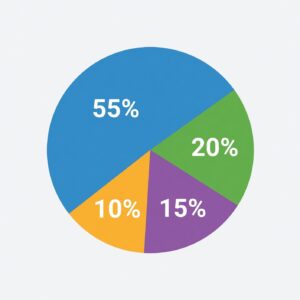
To achieve these historical benchmarks, you cannot leave your funds sitting in a traditional savings account, where inflation actively diminishes your purchasing power. Long-term wealth accumulation requires exposure to growth-oriented asset classes.
The Role of Equities (Stocks)
Equities represent partial ownership in real corporations. They carry higher short-term volatility but have historically outpaced all other major asset classes over multi-decade periods. Broad-market index funds or Exchange-Traded Funds (ETFs) tracking major indexes provide an efficient way to capture general market growth while mitigating single-stock risk.
Fixed-Income Securities (Bonds)
Bonds act as a stabilizing force within a portfolio. While they generally offer lower returns than stocks, they provide regular interest payments and experience less intense price fluctuations. A well-balanced portfolio often shifts its allocation toward fixed income as an investor approaches their target retirement date to protect accumulated capital.
Systematic Rebalancing
Over time, different assets grow at different speeds, altering your intended risk profile. If stocks perform exceptionally well, they may grow to represent a larger percentage of your portfolio than desired. Regular rebalancing—selling a portion of overperforming assets to buy underperforming ones—ensures you maintain your target risk tolerance while systematically buying low and selling high.
How Fees and Taxes Impact Capital Gains Over Time
While market returns accelerate your portfolio’s growth, investment costs and taxation act as opposing forces. Minimizing these drains is just as important as maximizing your gross returns.
The True Cost of Expense Ratios
Many mutual funds and ETFs charge an annual management fee known as an expense ratio. While a 1% fee might seem trivial on paper, it is applied to your entire balance year after year. Over a 30-year timeline, a 1% management fee can reduce your final portfolio value by tens of thousands of dollars compared to a low-cost index fund charging 0.05%. Every dollar saved on management fees remains in your account to compound.
Strategizing for Tax-Advantaged Accounts
Tax obligations can also reduce your long-term returns. Utilizing tax-advantaged investment structures allows your assets to grow much faster than they would in standard taxable accounts.
- Pre-Tax Vehicles: Contributions reduce your current taxable income, and the funds grow tax-deferred until you make withdrawals in retirement.
- Post-Tax (Roth) Vehicles: Contributions are made using after-tax dollars, meaning your investments grow completely tax-free, and qualified withdrawals in retirement incur no additional tax liability.
By minimizing fund expenses and utilizing appropriate tax structures, you preserve a larger capital base for the compounding mechanism to act upon, maximizing the final value of your portfolio.
The Core Strategy for Long-Term Wealth Building

Building a significant investment balance over 10, 20, or 30 years does not require complex trading strategies or predicting short-term market movements. Instead, it relies on a disciplined, automated process that works consistently across all market cycles.
By automating your contributions, you ensure that a set amount of income is directed toward your investments immediately after you receive your paycheck. This strategy, known as dollar-cost averaging, removes emotion from the investment process. When prices are high, your fixed contribution buys fewer shares; when prices decline during a market downturn, your fixed contribution naturally purchases more shares at a discount.
Ultimately, the calculations confirm that time is the most valuable asset available to an investor. The sooner you establish a regular, automated investment plan, the longer your capital has to move past the slow initial phases of growth and climb the steep, highly rewarding side of the compounding curve.