Bitcoin UTXO: What Is It and How Does It Work?
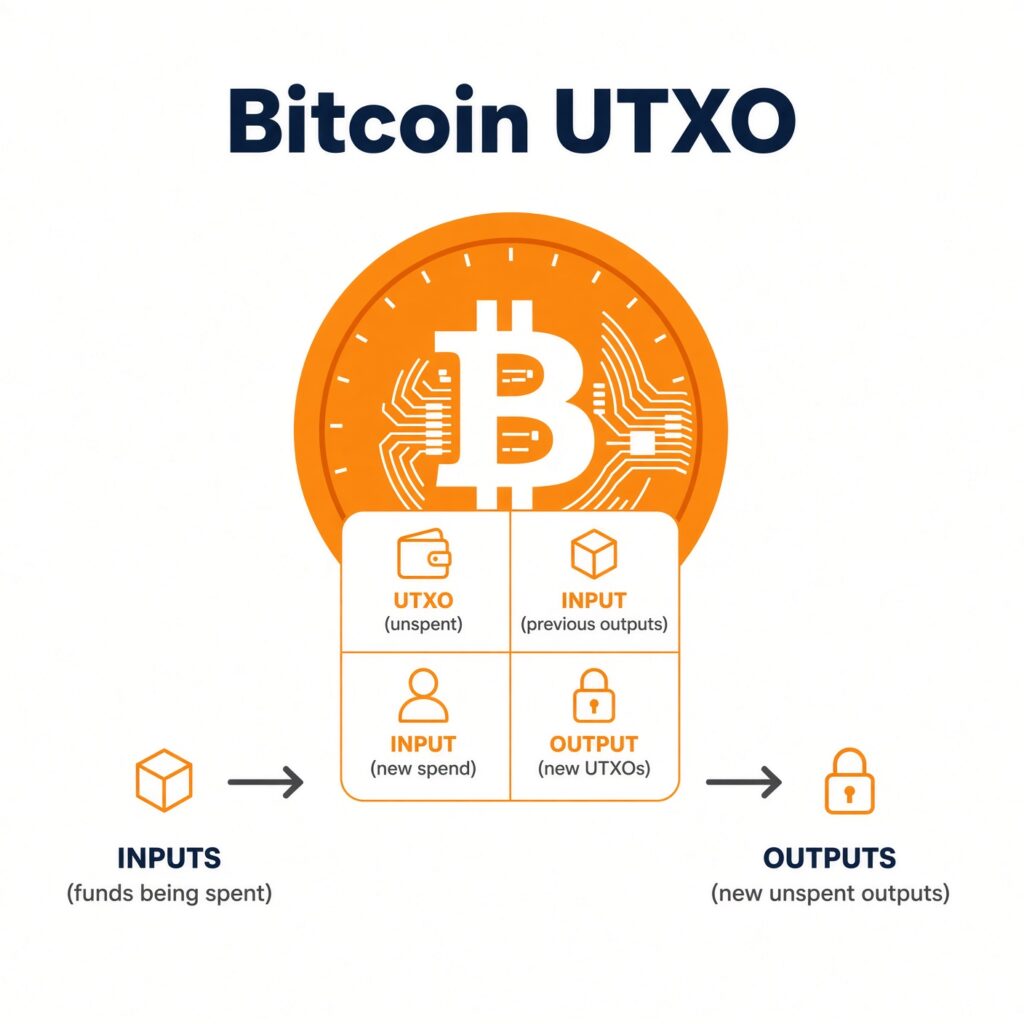
image for illustrative purposes only.
Understanding how Bitcoin functions beneath the surface requires looking past the simple concept of digital balances. Unlike traditional bank accounts that display a single, running balance of your funds, Bitcoin uses a completely different accounting model known as the Unspent Transaction Output, or UTXO model. Grasping this concept is essential for anyone looking to understand Bitcoin transactions, fee structures, privacy considerations, and the overall mechanics of the blockchain.
Understanding the Basics: Account Model vs. UTXO Model

To truly understand the UTXO model, it helps to compare it to something familiar: a traditional bank account or a digital payment service like PayPal.
In a traditional account-based model, your balance is tracked as a single numerical value in a database. If you have 1,000 dollars in your bank account and you send 200 dollars to a friend, the bank simply updates your ledger entry from 1,000 to 800, and your friend’s account increases by 200. Ethereum and most other modern smart-contract platforms use this same account-based model.
Bitcoin, however, does not work this way. Bitcoin does not have “accounts” or “balances” stored anywhere on its blockchain. Instead, Bitcoin uses the UTXO model.
Think of UTXOs like physical cash. Imagine you walk into a store with a single 100-dollar bill to buy an item that costs 20 dollars. You cannot slice 20 dollars off the physical bill. Instead, you hand over the entire 100-dollar bill to the cashier, and the cashier hands you back 80 dollars in change.
In the Bitcoin network, UTXOs are the digital equivalent of those physical bills and coins of varying denominations. There is no single balance attached to your wallet address; rather, your “wallet balance” is simply the aggregate sum of all the individual UTXOs that your wallet holds the private keys to spend.
What Exactly Is a UTXO?
An Unspent Transaction Output is precisely what its name implies: a chunk of Bitcoin cryptocurrency that has been locked to a specific owner on the blockchain and has not yet been spent in a subsequent transaction.
Every single transaction on the Bitcoin network consists of two primary components:
-
Inputs: UTXOs from previous transactions that you own and are now consuming.
-
Outputs: New UTXOs that are created as a result of the current transaction.
When you receive Bitcoin, you are not receiving a credit to an account balance. You are receiving a new UTXO that lists your public address as the designated receiver. To spend that Bitcoin in the future, your transaction must reference that specific UTXO as an input, prove that you hold the corresponding private key to unlock it, and consume it entirely.
A Simple Transaction Lifecycle Example
To see how this works in practice, let’s walk through a step-by-step transaction:
-
Step 1: Alice previously received 1 Bitcoin in a past transaction. This entire 1 Bitcoin sits in her wallet as a single UTXO.
-
Step 2: Alice wants to send 0.3 Bitcoin to Bob.
-
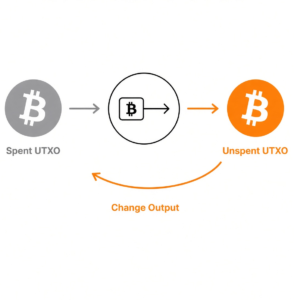
Step 3: Alice’s wallet constructs a transaction that takes her 1 Bitcoin UTXO as its input.
-
Step 4: The transaction creates two new outputs:
-
Output A: 0.3 Bitcoin locked to Bob’s address (this becomes a brand new UTXO belonging to Bob).
-
Output B: 0.699 Bitcoin sent back to a new address controlled by Alice (this is her “change,” forming a new UTXO).
-
-
Step 5: The remaining 0.001 Bitcoin is left unassigned to any output, which automatically serves as the transaction fee collected by the Bitcoin miner who includes this transaction in a block.
-
Step 6: Once validated and confirmed on the blockchain, Alice’s original 1 Bitcoin UTXO is marked as “spent” and can never be used again. Bob now has a 0.3 Bitcoin UTXO, and Alice has a 0.699 Bitcoin UTXO.
Why Bitcoin Uses the UTXO Model
Satoshi Nakamoto deliberately chose the UTXO model for Bitcoin for several crucial reasons relating to security, verification, and scalability.
Enhanced Parallel Processing and Validation
Because every UTXO is completely independent and self-contained, nodes on the Bitcoin network can verify transactions in parallel. To check if a transaction is valid, a node only needs to verify that the specific UTXOs being referenced as inputs actually exist, have not been spent yet, and that the cryptographic signatures match. This modularity makes validation fast and secure.
Solving the Double-Spending Problem
In digital currencies, the “double-spending problem” is the risk that a user might spend the exact same digital token twice. The UTXO model inherently prevents this. Once a UTXO is used as an input in a confirmed transaction, it is permanently marked as spent. Even if a malicious actor attempts to broadcast a second transaction using that same UTXO, the network will instantly reject it because the input no longer exists as an unspent output.
Granular Privacy Control
While the UTXO model can introduce privacy challenges, it also allows users to manage multiple addresses and UTXOs separately. Users can choose to segregate funds across different UTXOs, avoiding the linkage of all their financial holdings into a single monolithic account.
The UTXO Set and State Bloat
The collection of every single unspent transaction output currently active across the entire history of the Bitcoin network is known as the UTXO set.
Every full node on the Bitcoin network must maintain and constantly update this UTXO set in its active memory (RAM) to quickly validate incoming transactions. As of recent years, the UTXO set contains tens of millions of individual entries and occupies several gigabytes of memory.
The Challenge of UTXO Bloat
One of the ongoing technical discussions among Bitcoin core developers is UTXO bloat. This occurs when users generate a high volume of extremely small UTXOs—often referred to as “dust.”
If someone receives dozens of tiny payments (e.g., from mining payouts, micro-transactions, or airdrops), their wallet accumulates a large number of low-value UTXOs. Later, when they want to send a larger amount, their wallet must combine many of these tiny UTXOs as inputs to cover the transaction value.
Combining many inputs drastically increases the physical data size (in bytes) of the transaction. Because Bitcoin transaction fees are calculated based on data size (satoshis per byte) rather than the dollar value being sent, consolidating dust can sometimes result in transaction fees that cost more than the actual value of the UTXOs being spent.
UTXO Management and Transaction Fees
Because transaction fees depend directly on the size of the transaction data—measured in weight units or virtual bytes (vBytes)—managing your UTXOs efficiently is an important skill for advanced Bitcoin users.
Every input included in a transaction requires a certain amount of data space to store cryptographic signatures and reference scripts. Therefore, a transaction with ten inputs will take up significantly more block space than a transaction with a single input.
Best Practices for UTXO Optimization
-
Consolidate During Low-Fee Periods: When the Bitcoin mempool is clear and network fees drop to historic lows, users with many small UTXOs often choose to consolidate them by sending their funds to themselves in a single transaction. This merges multiple inputs into one clean, large UTXO, lowering future transaction costs when fees are high.
-
Leverage Native SegWit and Taproot: Modern Bitcoin address formats—such as Native SegWit (Bech32, starting with
bc1q) and Taproot (starting withbc1p)—drastically reduce the data footprint required for UTXO signatures. Using these modern address formats makes transactions lighter and more cost-effective. -
Coin Control Features: Advanced Bitcoin wallets feature a tool called “coin control,” which allows users to manually select which specific UTXOs they want to spend in a transaction, preventing accidental dust accumulation and preserving financial privacy.
Privacy Implications of the UTXO Model
Privacy on the Bitcoin blockchain is a nuanced topic largely dictated by the nature of UTXOs. Because the blockchain is an entirely public ledger, anyone can trace the history of a UTXO from its creation all the way to its consumption.
Address Reuse and Linkability
If a user repeatedly gives out the same Bitcoin address to receive payments, all of those payments will create separate UTXOs linked to that exact same address. Furthermore, if a transaction combines multiple UTXOs as inputs to pay a recipient, cryptographic analysis can easily deduce that all of those input UTXOs belonged to the same owner. This practice—known as heuristic clustering—allows blockchain analysis firms to map out wallet ownership.
Enhancing Privacy with Modern Techniques
To combat the transparency inherent in UTXO tracking, the Bitcoin ecosystem has developed several privacy-enhancing innovations:
-
Deterministic Wallets (Hierarchical Deterministic / HD Wallets): Modern wallets automatically generate a brand-new, unique receiving address for every single transaction you make, ensuring your UTXOs are scattered across various addresses rather than concentrated in one place.
-
CoinJoin Protocols: CoinJoin is a collaborative transaction method where multiple users combine their UTXOs and outputs into a single, massive transaction. Because all outputs look identical, it becomes mathematically difficult for outside observers to determine which output belongs to which input, effectively breaking the chain of transaction history.
-
Lightning Network: The Lightning Network operates as a Layer-2 scaling solution. Instead of settling every single transaction directly on the base layer UTXO set, users open a multi-signature payment channel and execute thousands of off-chain transactions instantly. Only the opening and closing balances are ever recorded as UTXOs on the main blockchain, vastly improving both scalability and privacy.
The Future of UTXOs in Bitcoin

The UTXO model remains the bedrock of Bitcoin’s architectural design. While alternative blockchains have experimented with account-based frameworks, data-storage models, or alternative consensus mechanisms, Bitcoin’s adherence to the UTXO model has proven resilient, highly secure, and exceptionally reliable over more than a decade of operation.
As the Bitcoin network continues to evolve through layer-2 integrations, taproot script expansions, and continuous software optimizations, managing and understanding UTXOs remains one of the most vital competencies for developers, node operators, long-term holders, and everyday participants alike. Whether you are transferring funds, optimizing your wallet for minimal fee exposure, or studying blockchain forensics, the unspent transaction output is the fundamental building block that makes the entire decentralized economy tick.