Centralized vs Decentralized Exchanges: What Is the Difference?
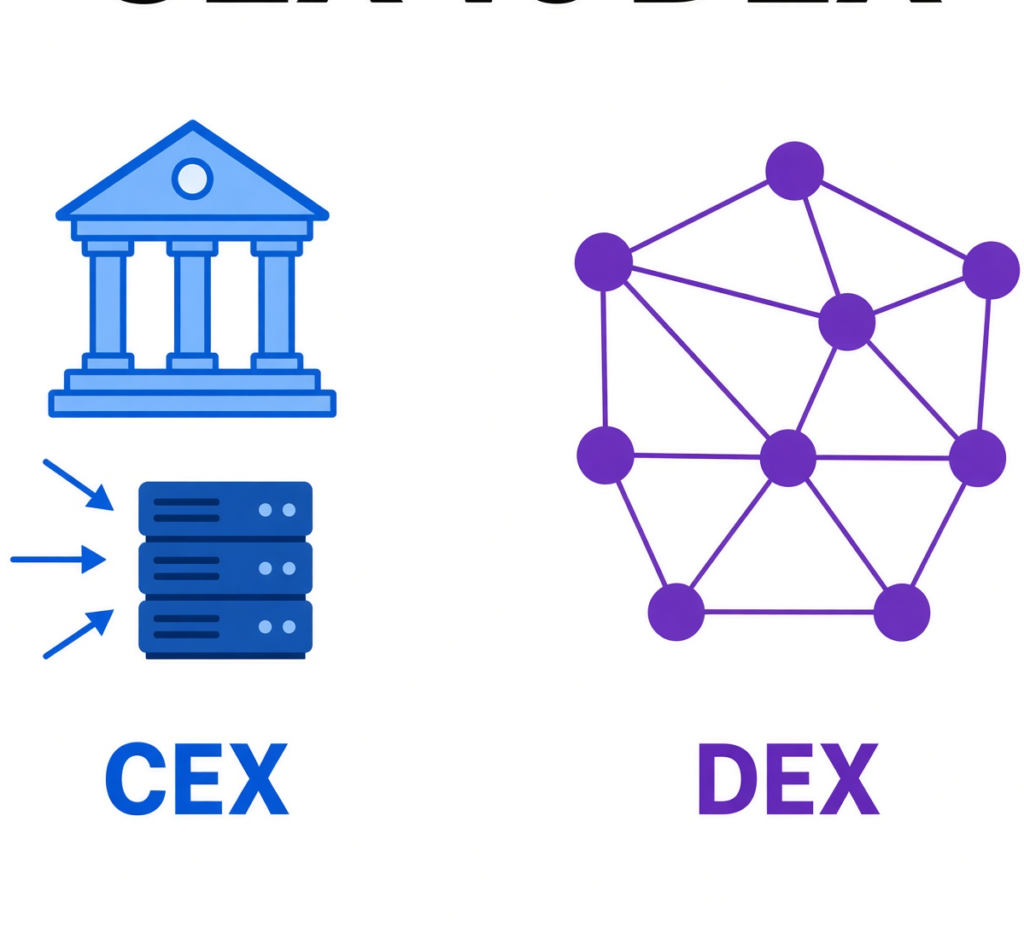
image for illustrative purposes only.
The digital asset landscape relies heavily on market access points where buyers and sellers meet. Choosing where to execute transactions is one of the foundational decisions any market participant makes. Understanding the mechanics that separate traditional broker-style platforms from automated, protocol-driven environments helps clarify how digital value moves across global markets.
Understanding Centralized Exchanges and Their Operational Architecture
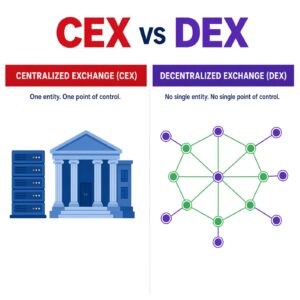
Centralized platforms function similarly to traditional financial institutions or stock brokerages. A corporate entity acts as an intermediary, managing the infrastructure, matching buyers with sellers, and maintaining internal ledgers to track user balances. When participants deposit funds into these environments, ownership of the private keys transfers to the operating company. The platform then handles the heavy lifting behind the scenes, using internal order books to execute trades instantly without requiring every single action to settle immediately on a public blockchain.
This corporate oversight creates a streamlined user journey. Account creation involves standard registration steps, often paired with identity verification procedures required by financial regulators. Because these platforms pool massive amounts of capital, they generally offer deep liquidity. High liquidity ensures that large orders execute smoothly without causing drastic price swings, making these environments attractive for both casual traders and high-volume professionals. Furthermore, dedicated support teams remain available to assist with account recovery, password resets, or transactional confusion, lowering the barrier to entry for newcomers entering the digital economy.
Exploring Decentralized Exchanges and Protocol-Driven Trading
In contrast, decentralized networks operate entirely through self-executing code known as smart contracts deployed on public blockchains. These environments eliminate corporate intermediaries entirely. Instead of routing trades through a company server or matching engine, participants connect their own non-custodial wallets and swap assets directly with peer-to-peer liquidity pools.
This structural shift transforms asset ownership. Participants retain absolute control over their private keys at every stage of the trading process. Because no corporate entity controls the underlying infrastructure, account registration, email addresses, and formal identity checks are unnecessary. Anyone anywhere with an internet-connected wallet can access the protocol instantly. This model introduces vast token selection, allowing participants to interact with early-stage projects, niche digital assets, and automated financial instruments long before they ever appear on corporate listings.
Core Differences in Asset Custody and Security Models
The divergence in custody represents the most significant dividing line between these two market structures. On a corporate-run platform, the operator safeguards the digital assets. This convenience means users can easily recover forgotten passwords or restore locked accounts through customer support channels. However, holding assets on an external server introduces counterparty risk. If the operating organization suffers a severe security breach, legal complications, or financial insolvency, user funds can become trapped or lost entirely.
Decentralized environments invert this paradigm through absolute self-sovereignty. Because assets remain inside personal wallets until a trade settles on-chain, participants face zero counterparty risk from an exchange operator. Security shifts entirely to individual responsibility. Losing a seed phrase or interacting with a malicious smart contract can result in permanent, irreversible loss of funds, as no corporate customer service department exists to reverse user errors. Additionally, protocol code itself can contain vulnerabilities, exposing liquidity pools to exploits if developers fail to audit their smart contracts rigorously.
Liquidity, Transaction Speeds, and Market Efficiency
Market efficiency depends heavily on how transactions are processed and matched. Corporate-run platforms maintain centralized order books, matching buy and sell orders with millisecond precision. This internal architecture delivers rapid execution speeds and tight spreads. Large institutional players rely on this deep liquidity to move substantial positions without suffering heavy market slippage.
Protocol-based environments utilize automated market makers (AMMs) rather than traditional order books. Instead of matching a buyer directly with a seller, trades execute against pooled capital supplied by other users. While major token pairs maintain robust depth, smaller or newer assets often suffer from lower liquidity. Lower liquidity leads to noticeable price slippage on larger trades. Furthermore, because every action requires blockchain validation, transaction speeds fluctuate based on network congestion, and participants must pay network transaction fees (gas) for every single interaction, regardless of whether a trade succeeds or fails.
Regulatory Compliance, Privacy, and Global Accessibility
Government oversight shapes how these digital marketplaces operate across different jurisdictions. Corporate trading hubs comply closely with regional financial laws, enforcing mandatory identity verification protocols (often referred to as Know Your Customer guidelines) and monitoring transactions for anti-money laundering compliance. This tight integration with traditional finance allows these platforms to support seamless fiat currency gateways—commonly known as on-ramps—enabling participants to deposit government-issued currency via bank transfer, wire, or credit card to purchase digital assets directly.
Decentralized platforms exist outside traditional corporate frameworks, operating as borderless, permissionless software protocols. They do not collect personal data, verify identities, or restrict access based on geographic registration. This complete absence of data collection provides maximum privacy for participants who value financial sovereignty and anonymity. However, this lack of regulatory integration means these protocols rarely support direct fiat currency deposits. Participants generally must acquire digital assets elsewhere before connecting to a protocol, creating a procedural hurdle for absolute beginners.
Evaluating User Experience and Learning Curves
Navigating these distinct digital environments requires vastly different levels of technical literacy. Corporate platforms focus heavily on polished user interfaces, mobile applications, and streamlined navigation designed to mimic traditional banking apps. Educational resources, guided walkthroughs, and responsive help desks ensure that individuals encountering digital assets for the first time can manage their portfolios with minimal friction.
Conversely, interacting with protocol-driven platforms demands a working understanding of digital wallet management, network configurations, token approvals, and transaction fee mechanics. Users must understand how to safely store recovery phrases, select appropriate gas limits, and navigate complex web interfaces. While modern decentralized aggregators have made significant strides in simplifying these interactions, the fundamental requirement for technical independence remains unchanged.
Strategic Integration and Finding the Right Balance

Many active participants discover that these two models are not mutually exclusive. Each environment serves distinct strategic purposes depending on immediate financial goals. Corporate hubs excel at onboarding fresh capital, converting government currencies into digital assets, executing high-volume trades, and offering structured financial products like staking and savings yields. They provide the infrastructure necessary for everyday portfolio management and seamless conversions.
Protocol-based alternatives shine when participants seek absolute autonomy, long-term self-custody, enhanced privacy, and access to the broader decentralized finance ecosystem. Engaging with yield farming, liquidity provisioning, and governance voting requires direct wallet connectivity that only code-driven exchanges can provide. Balancing these approaches allows market participants to leverage the speed and convenience of corporate platforms while utilizing the security of self-sovereign protocols for long-term asset holding.