Proof of Work and Proof of Stake: what are the differences?
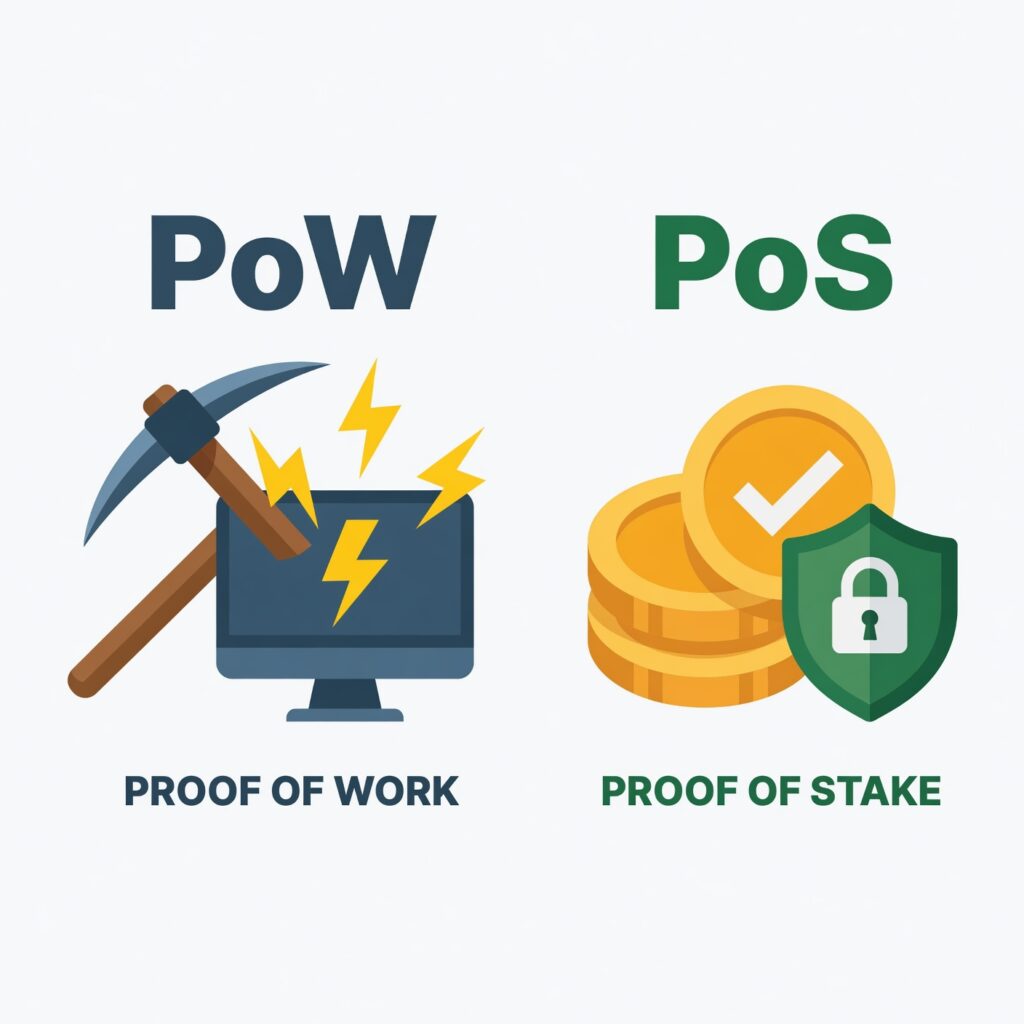
image for illustrative purposes only.
The digital asset ecosystem runs on decentralized networks where traditional intermediaries like banks or governments do not exist. Instead, global networks of computers must independently agree on the state of a shared ledger. This fundamental challenge is known as the consensus problem.
Without a central authority, how do participants trust one another? How do they prevent malicious actors from spending the same digital token twice—a critical flaw known as the double-spending problem?
The answer lies in consensus mechanisms: cryptographic protocols that secure blockchains and validate transactions. Among these mechanisms, two giants stand out, powering the vast majority of digital currencies in existence today: Proof of Work (PoW) and Proof of Stake (PoS).
Understanding the differences, advantages, and trade-offs between Proof of Work and Proof of Stake is essential for anyone navigating the modern financial landscape, whether you are an investor, a developer, or simply a technology enthusiast.
What is Proof of Work (PoW)?

Proof of Work (PoW) is the original consensus algorithm that brought blockchain technology to life. Introduced by the pseudonymous creator Satoshi Nakamoto in the foundational Bitcoin whitepaper in 2008, PoW laid the groundwork for the entire digital asset industry.
How Proof of Work Functions
At its core, Proof of Work relies on computational puzzle-solving. Transactions occurring on a PoW network are bundled into blocks. To add a new block to the blockchain, network participants known as miners must compete to solve an extremely complex mathematical puzzle through brute-force computation.
-
Trial and Error: Miners utilize specialized hardware called ASICs (Application-Specific Integrated Circuits) or powerful graphics processing units (GPUs) to run trillions of cryptographic guesses per second.
-
The Target Hash: The goal is to generate a specific cryptographic hash (a fixed-length string of characters) that falls below a target value set by the network’s difficulty adjustment algorithm.
-
Verification: Once a miner successfully guesses the correct solution, they broadcast the new block alongside the proof (the result of their computational effort) to the rest of the network. Other nodes can verify this proof almost instantaneously with a single computation.
-
Reward: As compensation for expending electricity, hardware wear-and-tear, and time, the winning miner receives newly minted cryptocurrency and transaction fees.
Security and Decentralization in PoW
Proof of Work is widely celebrated for its robust security model. To successfully alter a historical transaction on a mature PoW network like Bitcoin, an attacker would need to control more than 50% of the network’s total computational power, a scenario commonly referred to as a 51% attack. Achieving this requires an astronomical investment in physical hardware, real estate, cooling infrastructure, and electricity, making large-scale attacks economically unfeasible.
What is Proof of Stake (PoS)?
As blockchain technology matured, developers began seeking alternatives to the energy-intensive demands of Proof of Work. This quest led to the creation of Proof of Stake (PoS), an alternative consensus mechanism first conceptualized on online forums in 2011 and later implemented by various networks, most notably Ethereum during its historic network upgrade known as “The Merge.”
How Proof of Stake Functions
In a Proof of Stake system, the competitive race of computational puzzle-solving is completely eliminated. There are no miners, and specialized mining hardware is rendered unnecessary. Instead, network security and transaction validation are handled by validators.
-
Staking Capital: To become a validator, a participant must lock up a specific amount of the network’s native cryptocurrency in a smart contract. This locked capital is known as a stake.
-
Algorithmic Selection: Rather than racing to solve math puzzles, the network’s protocol algorithmically selects a validator to propose and sign the next block. The probability of being chosen is typically proportional to the size of the validator’s stake—the more coins a participant stakes, the higher their chances of selection.
-
Slashing Conditions: To prevent dishonest behavior, PoS protocols incorporate strict economic penalties called slashing. If a validator attempts to validate fraudulent transactions or goes offline maliciously, a portion of their staked tokens is automatically burned or confiscated by the network.
-
Rewards: Validators earn newly minted tokens and transaction fees for successfully proposing and attesting to blocks, yielding passive returns proportional to their locked capital.
Efficiency and Accessibility
Proof of Stake radically reduces the barriers to entry for network participation. While setting up an industrial-scale mining farm requires massive capital and access to cheap industrial electricity, participating in a PoS network can often be done directly from a home computer or through decentralized staking pools with modest financial commitments.
Direct Comparison: Proof of Work vs. Proof of Stake
To fully grasp the mechanics driving modern digital finance, it is helpful to evaluate Proof of Work and Proof of Stake across several core dimensions.
| Feature | Proof of Work (PoW) | Proof of Stake (PoS) |
| Primary Resource | Computational Power (Hashrate) | Capital (Staked Cryptocurrency) |
| Participant Title | Miner | Validator |
| Hardware Requirements | Expensive, specialized hardware (ASICs/GPUs) | Standard computers, laptops, or cloud nodes |
| Energy Consumption | Extremely high | Negligible (minimal power needed) |
| Attack Vector | 51% Computational Takeover | 51% Financial Stake Takeover |
| Transaction Finality | Probabilistic (depends on confirmation depth) | Deterministic (finalized via consensus checkpoints) |
| Prominent Examples | Bitcoin (BTC), Litecoin (LTC) | Ethereum (ETH), Cardano (ADA), Solana (SOL) |
Environmental Impact and Energy Consumption
One of the most intense debates surrounding blockchain technology focuses on environmental sustainability. This is where the divergence between Proof of Work and Proof of Stake becomes starkly apparent.
The Energy Footprint of Proof of Work
Proof of Work is intentionally designed to consume vast amounts of energy. The security of a PoW blockchain is directly tied to the cost of the electricity required to secure it. As the price of the underlying asset rises, more miners enter the market, total hashrate increases, and energy consumption climbs.
Critics argue that this energy expenditure is wasteful, contributing to global carbon emissions when powered by fossil fuels. Conversely, proponents emphasize that a significant percentage of global mining operations utilize stranded renewable energy, flare gas mitigation, and surplus hydroelectric power that would otherwise go to waste. Furthermore, supporters argue that securing a global, censorship-resistant monetary network justifies the energy cost.
The Sustainability of Proof of Stake
Proof of Stake addresses the energy debate head-on. Because PoS networks do not require high-powered computers running continuously to solve cryptographic puzzles, their electricity consumption drops by more than 99%.
For instance, when Ethereum transitioned from PoW to PoS, its total energy consumption plummeted instantly, transforming it into a green network. For institutional investors, venture capital funds, and environmentally conscious retail participants, the minimal carbon footprint of Proof of Stake removes a major hurdle to adoption.
Security Models and Economic Incentives
Both consensus mechanisms rely heavily on game theory and economic incentives to keep participants honest, but their attack vectors differ fundamentally.
Economic Security in PoW
In a Proof of Work system, an attacker must continuously spend massive amounts of electrical power and maintain dominant physical hardware to sustain a 51% attack. If the community chooses to hard fork the network to neutralize the attack, the attacker’s physical hardware cannot be easily repurposed for other chains, resulting in a total loss of invested capital. This creates an enormous economic deterrent against malicious behavior.
Economic Security in PoS
In a Proof of Stake system, security is maintained through cryptographic bonding and penalization. An attacker attempting a 51% attack must acquire a majority of the circulating token supply. However, purchasing massive amounts of a token on the open market drives the price up exponentially, making the attack prohibitively expensive.
Additionally, if a validator attempts foul play, the network protocol detects the infraction and executes slashing, instantly destroying the attacker’s capital. This creates a powerful self-correcting financial loop: attacking the network directly destroys the attacker’s own net worth.
Scalability, Speed, and Decentralization

As decentralized finance (DeFi) applications, non-fungible tokens (NFTs), and global payment systems scale to accommodate millions of daily users, network throughput becomes paramount.
The Scalability Dilemma
Blockchains face the famous Blockchain Trilemma, a concept stating that decentralized networks can only achieve two of three properties at any given time: decentralization, security, and scalability.
-
Proof of Work Bottlenecks: Because every full node must independently verify every transaction and every mined block, throughput is naturally constrained. Bitcoin, for example, processes roughly seven transactions per second with block times averaging ten minutes. Scaling PoW often requires secondary layer protocols, such as the Lightning Network, to handle high-frequency microtransactions.
-
Proof of Stake Adaptability: Proof of Stake networks often achieve higher native throughput and faster block confirmation times because validation does not require heavy industrial computations. Many modern PoS blockchains utilize innovative architectures, such as sharding or optimized validator sets, to process thousands of transactions per second while maintaining high levels of decentralization.
The Evolution of Hybrid and Emerging Consensus Models
Innovation in the digital asset space never stops. As developers experiment with new ways to optimize speed, security, and decentralization, several hybrid and alternative models have emerged.
Delegated Proof of Stake (DPoS)
A popular variation of traditional PoS is Delegated Proof of Stake (DPoS). In this model, everyday token holders do not validate transactions directly. Instead, they vote to elect a smaller, fixed number of delegates who handle block validation on behalf of the community. This dramatically increases transaction speeds and scalability, though critics argue it sacrifices a degree of decentralization by concentrating power among fewer elected validators.
Proof of Authority (PoA) and Proof of History (PoH)
-
Proof of Authority (PoA): Used primarily in private or consortium blockchains, PoA relies on pre-approved, trusted validator identities rather than stakes or computation, offering rapid transaction execution where absolute trustlessness is not required.
-
Proof of History (PoH): Developed by high-performance blockchains like Solana, PoH acts as a cryptographic clock that timestamps events before they are processed by validators, drastically accelerating consensus speeds across the network.
Coexistence in the Financial Ecosystem
The debate between Proof of Work and Proof of Stake is not a winner-take-all scenario. Both mechanisms serve distinct philosophies and architectural goals within the broader financial landscape.
Proof of Work remains the gold standard for absolute censorship resistance, maximum decentralization, and sound monetary policy. Bitcoin continues to demonstrate that a decentralized asset secured by physical energy and pure mathematics can endure global economic shifts without a central leader or corporate backing.
On the other hand, Proof of Stake powers the flexible, high-speed execution layers of modern decentralized finance. By prioritizing energy efficiency, rapid transaction finality, and complex smart contract execution, PoS networks serve as the foundational infrastructure for institutional finance, global tokenization, and decentralized applications.
As the digital asset industry continues to mature, both mechanisms will undoubtedly evolve, driving financial inclusion, technological innovation, and economic autonomy on a global scale.