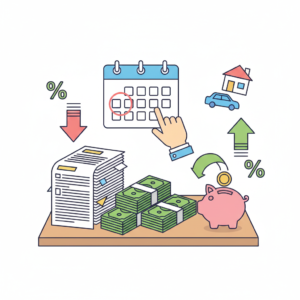
Step-by-step guide on how to create a retirement financial plan

Retirement is no longer just a “gold watch” and a rocking chair. In 2026, retirement represents the ultimate pivot—a transition from working for money to having your money work for you. However, with the global economy evolving through AI-driven shifts, fluctuating interest rates, and longer life expectancies, the old “save and hope” strategy is officially dead.
To achieve true financial independence, you need a dynamic, stock-market-centered financial plan. Whether you are 22 and just starting your first job or 52 and realizing the clock is ticking, this guide will walk you through the essential steps to building a portfolio that can withstand market volatility and fund your dreams.
Defining Your “Retirement Number”: How Much Do You Actually Need?

The biggest mistake most people make is aiming for a vague goal like “a million dollars.” In reality, your retirement number is unique to your lifestyle. To find it, you must start with your annual expenses.
The 25x Rule
A common benchmark in the financial world is the 25x Rule. This suggests that to retire comfortably, you should have 25 times your annual expenses invested. If you plan to spend $60,000 a year in retirement, you need a portfolio of $1.5 million.
The 4% Rule for Sustainable Withdrawals
Once you retire, how do you take money out without running out? The 4% Rule suggests that if you withdraw 4% of your total portfolio in the first year of retirement and adjust that amount for inflation every year after, your money has a high probability of lasting 30 years or more.
Factoring in 2026 Inflation
In today’s economy, “flat” numbers are dangerous. You must account for the rising cost of healthcare and travel. When calculating your retirement number, it is safer to aim for a 3.5% withdrawal rate to provide a buffer against the higher cost of living we see in 2026.
Assessing Your Current Financial Health: The Baseline Audit
You cannot plan a route to a destination if you don’t know your starting point. This requires a “Naked Audit” of your finances.
Calculating Your Net Worth
Your net worth is simply: Total Assets – Total Liabilities.
-
Assets: Cash, brokerage accounts, 401(k), home equity.
-
Liabilities: Student loans, credit card debt, mortgage balance.
The Debt-First Protocol
Before you dive deep into the stock market, you must address high-interest debt. If you have a credit card with a 22% interest rate, and the stock market historically returns 10%, you are losing money by investing instead of paying off that card. In 2026, “Financial Freedom” starts with a zero-balance on high-interest consumer debt.
Maximizing Tax-Advantaged “Buckets”: 401(k), IRA, and Beyond
Where you put your money is just as important as what you buy. In the US and globally, tax-advantaged accounts are the “cheat codes” of retirement planning.
| Account Type | Tax Benefit | Best For |
| Traditional 401(k) | Pre-tax contributions (Lower taxes now) | High earners looking for an immediate deduction. |
| Roth 401(k) / IRA | After-tax contributions (Tax-free growth) | Those who believe taxes will be higher in the future. |
| HSA (Health Savings Account) | Triple-tax advantage | The “Secret” retirement account for healthcare costs. |
The Employer Match: The Only “Free Lunch”
If your company offers a 401(k) match, that is a 100% return on your investment instantly. Never, under any circumstances, leave that money on the table. It is the foundation of your retirement plan.
The Stock Market as Your Growth Engine: Why You Can’t Just “Save”

In 2026, a standard savings account—even a “high-yield” one—will rarely beat inflation after taxes. To grow your wealth, you must be an owner, not just a saver. This means investing in the Stock Market.
The Power of Compounding
Compound interest is the “snowball effect” of the financial world. When your stocks pay dividends or increase in value, that “new” money earns its own returns the following year.
Stocks vs. Bonds in 2026
While bonds provide stability, stocks provide the growth necessary to outpace inflation. For a retirement plan, your “Equity (Stock) Allocation” should generally follow the 110 Minus Your Age rule. If you are 30, you should have 80% of your portfolio in stocks. If you are 60, you might drop that to 50%.
Crafting Your Asset Allocation: Diversification is Your Safety Net
You don’t need to find the “next big thing” to retire wealthy. In fact, trying to do so often leads to ruin. The most successful retirement plans rely on Asset Allocation.
The Three-Fund Portfolio
A popular and effective strategy for laypeople is the “Three-Fund Portfolio,” which consists of:
-
Total Domestic Stock Market Index: To capture the growth of your home country’s economy.
-
Total International Stock Market Index: To profit from global innovation.
-
Total Bond Market Index: To act as the “ballast” for your ship during market storms.
By owning these three, you own thousands of companies simultaneously. If one company fails, it doesn’t matter, because you own the others.
Automating Your Wealth: The “Set and Forget” Strategy
The biggest enemy of a retirement plan is human emotion. When the market drops, our brains scream at us to “do something” (which usually means selling at the bottom).
Dollar-Cost Averaging (DCA)
The best way to invest in 2026 is through automation. Set up a recurring transfer from your paycheck directly into your brokerage account. This is called Dollar-Cost Averaging.
-
When the market is high, your money buys fewer shares.
-
When the market is low (on “sale”), your money buys more shares.
-
Over 30 years, this mathematically lowers your average cost and removes the stress of “timing the market.”
The Role of AI and Modern Fintech in 2026 Retirement Planning
We are living in the age of “Smart Finance.” You no longer need to manually calculate your rebalancing or track every penny.
Robo-Advisors and Automated Rebalancing
Modern platforms now use AI to ensure your portfolio stays within your target risk level. If your stocks grow too fast and now represent 90% of your portfolio (when your goal was 70%), the AI will automatically sell the excess and buy bonds to keep you safe.
Real-Time Retirement Projection
In 2026, you should use tools that link to your actual accounts to give you a “Probability of Success” score. This helps you adjust your spending or saving habits in real-time, rather than waiting until you are 65 to realize you have a gap.
Managing “Sequence of Returns Risk”: The Danger Zone

As you approach the “Red Zone” (the 5 years before and after you retire), a new risk emerges: Sequence of Returns Risk.
What is it?
If the stock market crashes in the first year of your retirement while you are withdrawing money, it can permanently damage your portfolio’s ability to recover.
The Cash Bucket Strategy
To mitigate this, savvy retirees in 2026 keep 2 to 3 years of living expenses in cash or short-term bonds. If the market crashes, you don’t sell your stocks at a loss; you simply live off your “Cash Bucket” until the market recovers.
Healthcare and Longevity: The Hidden Retirement Expenses
In the 2020s and 2026, healthcare is the largest “unknown” in retirement planning. An average couple may need $300,000 to $400,000 just for medical expenses in retirement.
The HSA Advantage
If you have access to a High Deductible Health Plan (HDHP), the Health Savings Account (HSA) is your best friend.
-
Contributions are tax-deductible.
-
Growth is tax-free.
-
Withdrawals for medical expenses are tax-free.
After age 65, it essentially functions like a traditional IRA, but with the added bonus of tax-free medical payments.
Reviewing and Adjusting: The Dynamic Nature of Your Plan
A financial plan is not a “one and done” document. It is a living, breathing strategy.
Annual Check-ups
Once a year, you should review your plan. Has your lifestyle changed? Have you had a child or grandchild? Has the market shifted your allocation?
-
Rebalance: Bring your percentages back to your target.
-
Increase Contributions: Every time you get a raise, put 50% of that raise toward your retirement. You’ll never miss money you never saw in your bank account.
The Psychology of Retirement: Life After the Paycheck

Finally, a retirement plan isn’t just about the money—it’s about what the money is for. Many people retire with millions but find themselves unhappy because they lost their sense of purpose.
Designing Your “Second Act”
Your financial plan should fund your values. Do you want to travel? Volunteer? Start a small business? Ensure your portfolio is structured to provide the liquidity you need for these activities. Financial freedom is the ability to spend your time exactly how you want.
Start Where You Are
The best time to start a retirement plan was 20 years ago. The second best time is today. In 2026, the tools at your disposal are more powerful than ever. By following this step-by-step guide, you are taking control of your future and ensuring that your “Golden Years” are actually golden.
The stock market will go up, and it will go down. But over the long term, those who stay disciplined, stay diversified, and stay invested are the ones who cross the finish line with peace of mind.