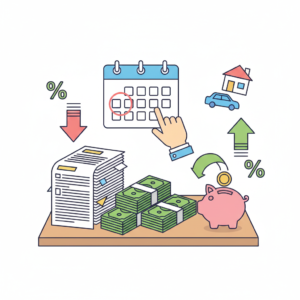
Learn how to take control of your money

Financial stress isn’t just about a lack of money; it’s often about a lack of control. For many, money feels like a wild animal—unpredictable and difficult to manage. But what if you could flip the script? What if every dollar you earned had a specific purpose, and you knew exactly where your finances would be six months, or even six years, from now?
Taking control of your money is the single most empowering move you can make for your future. It reduces anxiety, improves your health, and opens doors to opportunities you never thought possible. This guide is a deep dive into the mechanics of personal finance, designed for anyone who wants to stop being a passenger in their financial life and start being the driver.
The Psychology of Wealth: Why Your Mindset is Your Biggest Asset

Before we touch a calculator, we have to talk about your brain. Most people fail at personal finance not because they are bad at math, but because they haven’t addressed their “money scripts.” These are the unconscious beliefs we develop in childhood about wealth.
Overcoming the Scarcity Mindset
A scarcity mindset tells you that there will never be enough. This leads to two extremes: hoarding money out of fear or spending it the moment you get it because you assume it will disappear anyway. To take control, you must shift toward an Abundance Mindset, which focuses on long-term growth and the belief that financial stability is an achievable skill, not a stroke of luck.
The Power of Delayed Gratification
The modern world is designed to make you spend. From “Buy Now, Pay Later” schemes to targeted social media ads, everything pulls at your impulse triggers. Taking control means reclaiming your attention. Every time you delay a non-essential purchase, you are “buying” your future freedom.
Financial Auditing: How to Conduct a Deep Dive into Your Spending Habits
You cannot manage what you do not measure. A financial audit is the process of looking at your bank statements with a detective’s eye. It’s not about judgment; it’s about data.
Categorizing Your Cash Flow
To get a clear picture, categorize your spending for the last 90 days into three distinct pillars:
-
Fixed Obligations: Rent, mortgage, car payments, insurance, and utilities.
-
Variable Essentials: Groceries, gas, and healthcare.
-
Lifestyle Spending: Subscriptions, dining out, entertainment, and Amazon “oops” purchases.
Identifying the “Ghost Expenses”
Ghost expenses are the small, recurring charges that haunt your bank account without providing value. That $12 gym membership you haven’t used in six months? The $5 premium app subscription for a game you don’t play? These are leaks in your financial ship. Plugging these leaks is the easiest way to “give yourself a raise” without working extra hours.
The Modern Budgeting Blueprint: Moving Beyond Traditional Bookkeeping
Many people hate the word “budget” because it feels like a diet. Instead, think of a budget as a Spending Plan. It’s not about telling yourself you can’t spend; it’s about deciding how you will spend.
The Zero-Based Budgeting Method
This is one of the most effective strategies for financial control. In zero-based budgeting, your income minus your expenses must equal zero. Every dollar is assigned a job—whether that job is “Paying the Electric Bill,” “Investing in an Index Fund,” or “Friday Night Pizza.” When every dollar has a name, “mystery spending” disappears.
The 50/30/20 Rule for Simplicity
If zero-based budgeting feels too tedious, try the 50/30/20 rule:
-
50% for Needs: The absolute basics.
-
30% for Wants: The things that make life fun.
-
20% for Savings and Debt: This is your “future self” fund.
Strategic Debt Management: Turning the Tide on High-Interest Rates

Debt is often the biggest barrier to financial control. It’s hard to build a house on a foundation of sand. To take control, you need a battle plan to eliminate high-interest debt, specifically credit cards.
The Debt Snowball vs. The Debt Avalanche
-
The Debt Snowball: You pay off your smallest balances first. This creates a psychological win that keeps you motivated.
-
The Debt Avalanche: You pay off the debt with the highest interest rate first. Mathematically, this saves you the most money.
If you are someone who thrives on quick wins, go with the Snowball. If you are strictly driven by the numbers, the Avalanche is your best bet.
Dealing with Student Loans and Mortgages
Not all debt is created equal. Low-interest, tax-advantaged debt (like some student loans or mortgages) shouldn’t necessarily be your first priority if you have credit card debt at 24% APR. Prioritizing high-interest “bad debt” is the fastest way to increase your net worth.
Building Your Fortress: The Essential Emergency Fund
Life is unpredictable. If you don’t have a cash buffer, every “emergency” becomes a financial catastrophe that forces you back into debt.
The Starter Fund
Your first milestone is $1,000 to $2,500. This is your “Safety Net 1.0.” It’s designed to cover a blown tire, a broken window, or a minor medical bill.
The Fully-Funded Emergency Account
Once your high-interest debt is gone, aim for 3 to 6 months of living expenses. This money should be kept in a High-Yield Savings Account (HYSA). It shouldn’t be invested in the stock market because you need it to be liquid and stable. Having this fund is the ultimate “stress killer.”
Maximizing Your Income: The Art of the Side Hustle and Career Growth
While cutting expenses is vital, there is a limit to how much you can cut. There is no limit, however, to how much you can earn.
Investing in “Human Capital”
The best return on investment (ROI) you will ever get is in your own skills. Taking a certification course, learning a new software, or improving your public speaking can lead to a 10% or 20% jump in your salary.
Diversifying Income Streams
Don’t rely on a single source of income. Whether it’s freelance consulting, selling digital products, or a part-time gig, having a secondary income stream provides a safety net if your primary job is ever at risk.
Automation: How to Put Your Financial Growth on Autopilot

The biggest enemy of financial control is human friction. If you have to manually move money into savings every month, eventually, you’ll forget—or you’ll talk yourself out of it.
The “Pay Yourself First” Principle
Set up an automatic transfer from your checking account to your savings or investment account the same day your paycheck hits. If you never see the money in your spending account, you won’t miss it.
Automating Bill Payments
Avoid late fees and credit score dings by automating your fixed expenses. Most banks allow you to set up recurring payments for utilities, rent, and insurance. This frees up “mental RAM” so you can focus on more important things.
The Role of Credit Scores in Long-Term Wealth Building
In the modern financial landscape, your credit score is your “financial GPA.” A high score allows you to borrow money at lower rates, which can save you hundreds of thousands of dollars over the life of a mortgage.
How to Boost Your Score Safely
-
Payment History: Always pay on time. Even one late payment can tank your score.
-
Credit Utilization: Keep your balances below 30% of your total limit.
-
Length of Credit History: Don’t close your oldest accounts, even if you don’t use them much.
Investing for the Future: Making Your Money Work as Hard as You Do
Once you’ve mastered the basics of budgeting and debt, it’s time to move into the wealth-building phase. Investing is the process of buying assets that put money back into your pocket.
The Power of Compound Interest
$100 invested today is worth significantly more than $100 invested ten years from now. By starting early, you let time do the heavy lifting.
Retirement Accounts: 401(k) and IRAs
If your employer offers a 401(k) match, take it. It is literally free money. Beyond that, consider an Individual Retirement Account (IRA). These accounts offer significant tax advantages that help your money grow faster.
Low-Cost Index Funds
You don’t need to be a Wall Street expert to win at investing. Low-cost index funds allow you to own a tiny piece of hundreds of successful companies. This diversification protects you from the failure of any single company while allowing you to benefit from the growth of the overall economy.
Smart Consumerism: Breaking the Cycle of Impulse Buying
Taking control of your money requires a change in how you shop. We live in a “one-click” culture that rewards impulsivity.
The 24-Hour Rule
For any non-essential purchase over $50, wait 24 hours. Often, the “must-have” feeling disappears after a night of sleep.
Quality Over Quantity
Sometimes, the cheapest option is the most expensive in the long run. Buying a high-quality pair of boots that lasts five years is cheaper than buying a $20 pair every six months. This “Buy It For Life” (BIFL) mentality is a key trait of financially savvy individuals.
Insurance and Protection: Safeguarding Your Financial Success

You’ve worked hard to take control of your money; now you need to protect it. One lawsuit or major illness can wipe out years of progress if you aren’t properly insured.
Essential Coverage
-
Health Insurance: A non-negotiable.
-
Term Life Insurance: Especially important if you have dependents.
-
Disability Insurance: Protects your greatest asset—your ability to earn an income.
-
Umbrella Insurance: For those who have built significant assets and want an extra layer of liability protection.
Teaching the Next Generation: Why Financial Literacy Starts at Home
Financial control isn’t just for you—it’s a legacy. Talking to your children about money, showing them how a budget works, and explaining the concept of interest can break generational cycles of poverty or financial mismanagement.
The Freedom That Comes with Control
Taking control of your money is a marathon, not a sprint. There will be months where you overspend, and there will be unexpected expenses that set you back. The goal isn’t perfection; it’s persistence.
When you control your money, you control your time. And when you control your time, you control your life. Start small, automate your systems, and keep your eyes on the long-term prize. You’ve got this.