What Are the Main Types of Investments?
image for illustrative purposes only.
Understanding the Fundamentals of Asset Classes and Portfolio Diversification

Before diving into specific investment vehicles, it is crucial to understand what an asset class is. An asset class is a grouping of similar investment types that exhibit similar characteristics, behave similarly in the marketplace, and are subject to the same laws and regulations. The primary traditional asset classes include stocks, bonds, and cash equivalents. Modern portfolios often expand into alternative investments such as real estate, commodities, and digital assets.
Diversification is the practice of spreading your investments across various asset classes to reduce overall portfolio risk. The core philosophy behind diversification is that different assets perform differently under varying economic conditions. When stocks experience a downturn, bonds or commodities may hold steady or increase in value. By avoiding putting all your financial eggs in one basket, you protect your capital from severe volatility and position your portfolio for steady, compounding growth over decades.
Equities (Stocks): Owning a Piece of Publicly Traded Corporations
Equities, commonly referred to as stocks or shares, represent fractional ownership in a publicly traded corporation. When you purchase a share of stock, you become a shareholder, meaning you own a tiny fraction of that company’s underlying business operations, assets, and future earnings potential. Historically, equities have delivered higher long-term returns compared to almost every other traditional asset class, making them the primary engine for capital appreciation in most investment portfolios.
Stocks generally generate returns through two main mechanisms: capital appreciation and dividends. Capital appreciation occurs when the market price of the stock rises above your purchase price, allowing you to sell it for a profit. Dividends, on the other hand, represent a direct distribution of a company’s profits paid out to shareholders on a regular schedule, typically quarterly. Established, financially stable corporations—often referred to as blue-chip stocks—frequently pay reliable dividends, providing investors with a steady stream of passive income.
However, equities also carry higher volatility and risk. Share prices fluctuate daily based on corporate earnings reports, macroeconomic indicators, industry trends, geopolitical events, and overall market sentiment. To mitigate single-company risk, investors often utilize mutual funds or exchange-traded funds (ETFs) that hold hundreds or thousands of individual stocks across diverse sectors and geographic regions.
Fixed-Income Securities (Bonds): Lending Capital for Steady Interest Payments
Fixed-income securities, primarily known as bonds, operate on a fundamentally different principle than stocks. When you buy a bond, you are essentially acting as a bank; you are lending money to an entity—such as a corporation, municipality, or national government—for a predetermined period in exchange for regular interest payments, known as coupon payments. At the end of the bond’s lifespan, known as the maturity date, the issuer returns your initial principal investment in full.
Bonds are generally considered much safer and less volatile than stocks, serving as a vital defensive anchor during market corrections. Government bonds, particularly U.S. Treasury securities, are backed by the full faith and credit of the issuing government and carry minimal default risk. Corporate bonds typically offer higher interest yields because corporations carry a higher risk of financial distress compared to sovereign governments.
The primary risks associated with fixed-income investments include interest rate risk and inflation risk. When market interest rates rise, the market value of existing bonds with lower fixed coupon rates tends to decline. Furthermore, if the rate of inflation outpaces the bond’s fixed yield, the real purchasing power of your investment diminishes over time. Balancing bonds with equities creates a harmonious asset allocation strategy tailored to your timeline.
Cash and Cash Equivalents: Preserving Capital and Ensuring Liquidity
Cash and cash equivalents represent the most liquid and secure category of investments. This asset class includes physical currency, traditional savings accounts, high-yield savings accounts, money market accounts, certificates of deposit (CDs), and short-term government treasury bills. These instruments are designed to protect your principal capital while offering immediate access to funds when unexpected expenses or emergencies arise.
The primary advantage of cash equivalents is safety and liquidity. Bank deposits up to regulatory limits are typically protected by federal insurance, ensuring you will not lose your principal balance due to market downturns. This makes cash the ideal home for your emergency fund, short-term savings goals, and money earmarked for upcoming major purchases within a one-to-three-year horizon.
The major drawback of holding excessive cash is inflation risk and low returns. Because cash equivalents offer minimal yield, their growth often fails to keep pace with the rising cost of living. Over long investing horizons, keeping all your wealth in cash results in a gradual loss of purchasing power. Therefore, cash is best utilized as a tactical stabilizing component of a broader, growth-oriented portfolio rather than a standalone wealth-building vehicle.
Real Estate Investments: Generating Income and Tangible Asset Growth
Real estate represents a tangible asset class encompassing physical property, land, commercial buildings, residential housing, and industrial complexes. Real estate investing has long been favored by individuals and institutions alike due to its unique ability to generate dual-stream returns: regular rental income and long-term capital appreciation driven by property value growth and urbanization.
Investors can participate in the real estate market through several distinct pathways. Direct real estate ownership involves purchasing residential rental properties, commercial spaces, or fix-and-flip houses, giving the investor total operational control but requiring significant capital, property management expertise, and maintenance upkeep. Alternatively, investors can buy shares in Real Estate Investment Trusts (REITs)—corporations that own, operate, or finance income-producing real estate across various sectors.
REITs trade on major stock exchanges like traditional equities, allowing everyday investors to gain exposure to institutional-grade real estate without needing massive capital or dealing with tenants and clogged plumbing. Furthermore, real estate often exhibits a low correlation with traditional stock and bond markets, serving as an exceptional inflation hedge since property values and rental rates typically adjust upward alongside rising consumer prices.
Mutual Funds and Exchange-Traded Funds (ETFs): Instant Portfolio Diversification

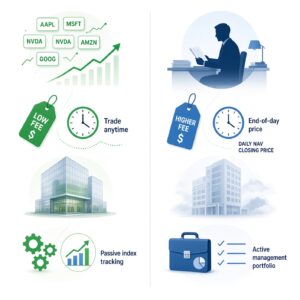
For modern investors looking to maximize efficiency and minimize the immense research required to pick individual stocks, mutual funds and exchange-traded funds (ETFs) offer an ideal solution. A mutual fund or ETF is a pooled investment vehicle managed by professionals or structured around automated market indexes. When you buy a share of an index fund, you instantly purchase a tiny fraction of hundreds or thousands of different securities simultaneously.
The primary benefit of funds is instant diversification. Instead of risking your entire capital on a handful of individual corporate stocks, a broad-market ETF spreads your money across entire sectors, countries, or asset classes. This dramatically minimizes single-stock volatility while capturing the broader upward trajectory of global economic growth.
Funds generally fall into two operational categories: passively managed index funds and actively managed funds. Passively managed funds track a specific benchmark index—such as the S&P 500—with minimal administrative overhead and exceptionally low expense ratios. Actively managed funds employ professional portfolio managers who attempt to outperform the broader market through strategic research and tactical trading, typically accompanied by higher management fees that can eat into long-term compounding returns.
Commodities: Hedging Against Inflation with Physical Raw Materials
Commodities are basic physical goods and raw materials traded on specialized global exchanges. This asset class is broadly divided into several distinct categories: precious metals (such as gold, silver, and platinum), energy products (crude oil, natural gas, and gasoline), agricultural goods (corn, wheat, soybeans, and coffee), and industrial metals (copper, aluminum, and zinc).
Investing in commodities serves a specific purpose in comprehensive financial planning: acting as a hedge against inflation and geopolitical instability. When consumer prices skyrocket and fiat currencies lose purchasing power, tangible assets like precious metals and energy resources frequently surge in value. Gold, in particular, has maintained its status as a timeless safe-haven asset during periods of systemic financial crisis and currency devaluation.
Retail investors rarely take physical delivery of crude oil barrels or agricultural wheat silos. Instead, commodity exposure is typically achieved through commodity-focused ETFs, mutual funds, futures contracts, or shares in mining and agricultural production companies. While commodities add valuable non-correlated diversification, they can be highly volatile and do not generate recurring dividends or interest payments, relying entirely on price appreciation.
Alternative Investments: Venturing Beyond Traditional Market Boundaries
Alternative investments encompass a vast, dynamic spectrum of non-traditional asset classes that fall outside the standard categories of stocks, bonds, and cash. This sophisticated category includes private equity, venture capital, hedge funds, cryptocurrency, art, rare collectibles, peer-to-peer lending, and intellectual property rights. Historically reserved for institutional investors and ultra-high-net-worth individuals, modern financial technology has opened up many alternative avenues for everyday retail investors.
Private equity and venture capital involve investing private capital directly into early-stage startups or privately held companies before they go public. While these investments carry extreme illiquidity and high failure rates, successful startup investments can yield exponential, life-changing financial returns. Cryptocurrency—led by digital assets like Bitcoin and Ethereum—has emerged as a decentralized alternative currency and store of value, characterized by extreme price volatility and cutting-edge blockchain utility.
While alternative investments can supercharge portfolio growth and provide unique uncorrelated returns, they also introduce higher regulatory uncertainty, complexity, illiquidity, and steep fee structures. Financial advisors generally recommend limiting alternative investments to a small, calculated percentage of an overall well-balanced portfolio.
How to Determine Your Personal Risk Tolerance and Investment Horizon
Selecting the right mix of investment types is not a one-size-fits-all endeavor; it requires deep self-reflection regarding your personal risk tolerance and time horizon. Your risk tolerance reflects your emotional and financial capacity to endure market volatility and potential temporary portfolio losses without panicking and selling at the absolute bottom. Younger investors with decades until retirement can typically stomach higher volatility in pursuit of aggressive equity growth, while individuals approaching retirement prioritize capital preservation and steady income.
Your investment horizon refers to the exact timeline you have before you will need to withdraw and spend your invested principal. Short-term goals—such as buying a car or funding a wedding within two years—demand secure, liquid cash equivalents. Long-term goals—such as funding a retirement account or children’s education twenty or thirty years down the road—allow you to leverage high-growth asset classes like equities and real estate, comfortably riding out inevitable short-term market cycles.
Crafting Your Balanced Long-Term Wealth Strategy

Building sustainable wealth is a marathon, not a sprint. By understanding the main types of investments—from growth-driving equities and defensive bonds to stable cash, tangible real estate, diversifying funds, and inflation-hedging commodities—you possess the foundational knowledge needed to construct a resilient financial future. Assess your personal goals, define your timeline, embrace disciplined diversification, and take consistent action toward achieving true financial independence.